Free IB Maths AI SL lesson: Combined events & sample-space diagrams
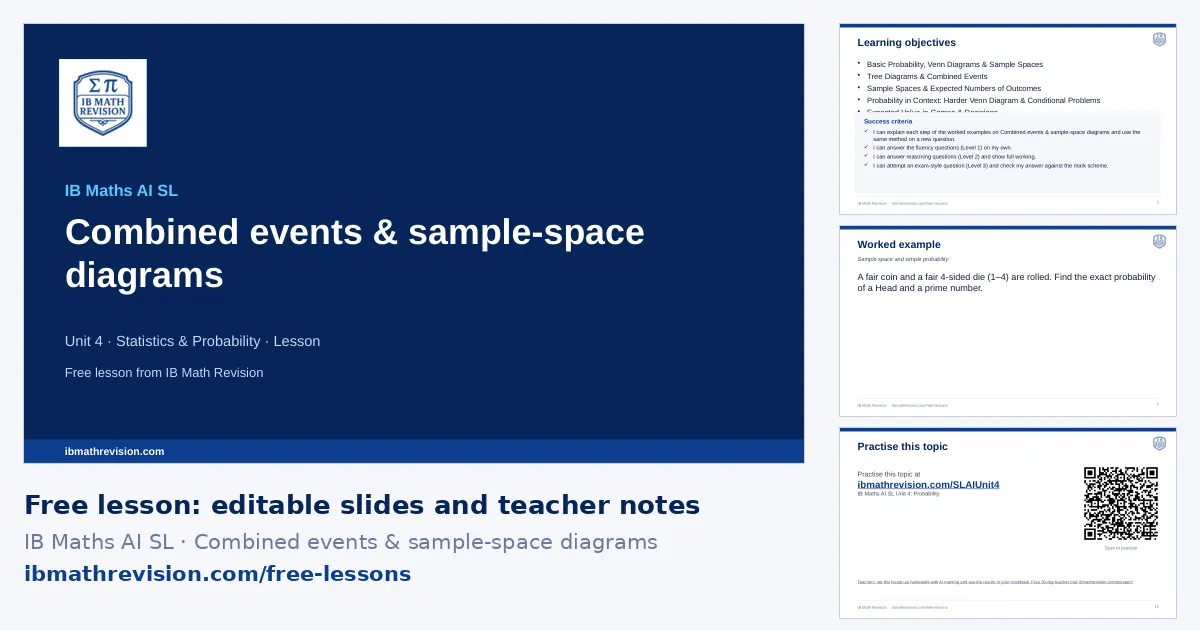
A ready-to-teach IB Maths AI SL lesson on Combined events & sample-space diagrams (Unit 4 · Statistics & Probability): editable slides and teacher notes, free; a printable worksheet in 3 levels with answers for school plans. About 55 minutes.
Free with a teacher account. Sign in with Google, Microsoft or email and download the slides and teacher notes.
What's inside
- Slides (PowerPoint, editable) · freeabout 12 slides: do now, objectives, key ideas, a worked example step by step, “your turn”, practice QR code, exit ticket
- Teacher notes (PDF) · freelesson plan with timings, common mistakes, homework links
- Worksheet (PDF) · school plans6 questions, 28 marks: Fluency, Reasoning, Exam-style. Included with school plans and the teacher trial.
- Answers (PDF) · school plansthe answer to every worksheet question, from its mark scheme. Included with school plans and the teacher trial.
Learning objectives
- Basic Probability, Venn Diagrams & Sample Spaces
- Tree Diagrams & Combined Events
- Sample Spaces & Expected Numbers of Outcomes
- Probability in Context: Harder Venn Diagram & Conditional Problems
Key ideas on the slides
- P(A′) = 1 − P(A); P(A ∪ B) = P(A) + P(B) − P(A ∩ B).
- Mutually exclusive: P(A ∩ B) = 0, so P(A ∪ B) = P(A) + P(B).
- For equally likely outcomes, P(A) = (n(A))/(n(U)); list the sample space or use a table.
- On a Venn diagram, fill the intersection first; all regions add to 1 (or the total).
By the end of the lesson, students should be able to answer a question like: Find P(A or B) if P(A)=0.4, P(B)=0.5, and P(A and B)=0.2.
Skills in this topic
Combined events & sample-space diagrams breaks down into 2 skills. In the worksheet builder, teachers can set practice on just one of them.
- Venn diagrams
- Sample spaces & tree diagrams
Key vocabulary
- sample space: The set of all possible outcomes.
- event: A set of outcomes.
- complement: A′, the event that A does not happen.
- mutually exclusive: Events that cannot both happen.
- population: The whole group being studied.
Common mistakes this lesson tackles
- Probability: adding instead of multiplying, conditional sample spaces, without replacement. Draw the tree or table. Along a branch multiply; between outcomes add. For "given that", the denominator is the size of the given group. Without replacement, the second probability changes.
- Basic statistics: range as an interval, frequency tables, outlier fences, Spearman's ranks. Range = largest − smallest (one number). Enter values and frequencies as two lists on the GDC. An outlier is beyond Q₁ − 1.5 × IQR or Q₃ + 1.5 × IQR; compare the actual data with the fence. Spearman's is between the ranks of the two variables.
- Adding P(A) + P(B) without subtracting the overlap.
- Assuming events are mutually exclusive without checking.
The worked example
A fair coin and a fair 4-sided die (1–4) are rolled. Find the exact probability of a Head and a prime number.
- Sample space (8 outcomes): {H1,H2,H3,H4,T1,T2,T3,T4}.
- Primes on die: 2 and 3 (1 is not prime).
- Favourable: {H2, H3}, so 2 outcomes.
- Fraction: 2/8.
- Simplify: 0.25 (or ¼).
Tip: Listing the full sample space visually (grid/table) prevents missing overlapping outcomes under exam pressure.
Calculator tips
- No GDC step needed; fractions keep answers exact.
- Use the random-integer function (RandInt) to choose items for a simple random sample.
Where this lesson fits
Combined events & sample-space diagrams is in Unit 4 · Statistics & Probability of the IB Maths AI SL scheme of work.
- The lesson before: Chi-squared goodness-of-fit test (scheme-of-work lessons: Goodness of Fit — Degrees of Freedom & Conclusions in Context; Goodness of Fit to Uniform & Given-Ratio Distributions)
- The next lesson: Conditional probability (scheme-of-work lessons: Conditional Probability & Independence; Two-Way Tables & Conditional Probability)
Lesson plan
| 0–5 min | Do now: students write down what they remember about Chi-squared goodness-of-fit test and Chi-squared test for independence |
| 5–8 min | Share the learning objective and success criteria |
| 8–20 min | Teach: the worked example, step by step; students copy the method |
| 20–25 min | Your turn: 1 mini-whiteboard question; check every board before moving on |
| 25–42 min | Practise: the worksheet (6 questions in 3 levels, with school plans and the teacher trial) or the topic's practice questions online; move up a level after two right in a row |
| 42–47 min | Plenary: 1-question exit ticket; collect it to plan the next lesson |
For students: practise this topic
The worksheet's QR code opens the IB Maths AI SL Unit 4: Probability practice questions.
With a school plan
Set Combined events & sample-space diagrams as homework marked by AI, print this lesson's levelled worksheet with answers, and rebuild the lesson for your class with Create lesson. Free for 30 days as a teacher, no card.
Is it free, can I edit the slides, what do students use for homework? See questions teachers ask.