Free IB Maths AI SL lesson: Approximation & rounding
A ready-to-teach IB Maths AI SL lesson on Approximation & rounding (Unit 1 · Number & Algebra): editable slides and teacher notes, free; a printable worksheet in 3 levels with answers for school plans. About 55 minutes.
Free with a teacher account. Sign in with Google, Microsoft or email and download the slides and teacher notes.
What's inside
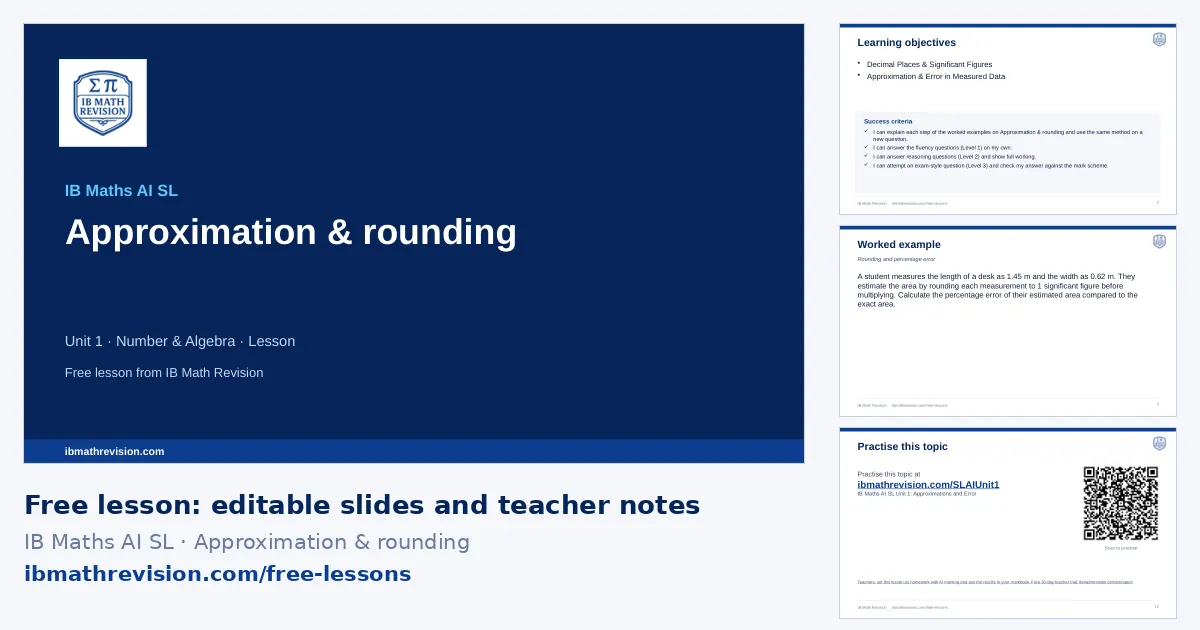
- Slides (PowerPoint, editable) · freeabout 12 slides: do now, objectives, key ideas, a worked example step by step, “your turn”, practice QR code, exit ticket
- Teacher notes (PDF) · freelesson plan with timings, common mistakes, homework links
- Worksheet (PDF) · school plans6 questions, 24 marks: Fluency, Reasoning, Exam-style. Included with school plans and the teacher trial.
- Answers (PDF) · school plansthe answer to every worksheet question, from its mark scheme. Included with school plans and the teacher trial.
Learning objectives
- Decimal Places & Significant Figures
- Approximation & Error in Measured Data
Key ideas on the slides
- For decimal places, count digits after the decimal point; for significant figures, count from the first non-zero digit: 0.004 736 is 0.00474 to 3 s.f.
- Look at the next digit: 5 or more rounds up, 4 or less rounds down. Keep place-holding zeros: 48 260 to 2 s.f. is 48 000.
- To estimate, round every number to 1 significant figure, then calculate: (48.7 × 3.1)/0.52 ≈ (50×3)/0.5 = 300.
- Keep full accuracy until the end and round only the final answer to the accuracy asked for (3 s.f. is the usual default when none is given).
By the end of the lesson, students should be able to answer a question like: Round 34.5678 to three significant figures.
Key vocabulary
- significant figure: A digit that carries meaning, counted from the first non-zero digit.
- decimal place: A digit position after the decimal point.
- estimate: An approximate answer found by rounding the numbers first.
Common mistakes this lesson tackles
- Accuracy: 2 s.f. answers, early rounding, and ignoring the accuracy asked for. Write the full calculator value, then round once: 3 s.f. unless the question says otherwise (keep trailing zeros). Read each question for its own rounding instruction and for context (whole years, whole items).
- Dropping place-holding zeros when rounding a large number: 48 260 to 2 s.f. is not 48.
- Counting the leading zeros of 0.00473 as significant figures.
- Rounding in the middle of a calculation and carrying the rounded value forward.
The worked example
A student measures the length of a desk as 1.45 m and the width as 0.62 m. They estimate the area by rounding each measurement to 1 significant figure before multiplying. Calculate the percentage error of their estimated area compared to the exact area.
- Round the measurements to 1 s.f.: L ≈ 1 m and W ≈ 0.6 m.
- Calculate the estimated area: A_E = 1 × 0.6 = 0.6 m².
- Calculate the exact area: A_A = 1.45 × 0.62 = 0.899 m².
- Substitute into ε = | (v_A − v_E)/(v_E) | × 100%: | (0.6 − 0.899)/0.899 | × 100%.
- Evaluate: 33.259…%. Percentage error = 33.3%.
Tip: Always use the unrounded exact value in the denominator of the percentage-error formula. The absolute value bars mean your final answer must be positive.
Calculator tips
- Store unrounded intermediate answers (Ans or the memory keys) and round once at the end.
Where this lesson fits
Approximation & rounding is in Unit 1 · Number & Algebra of the IB Maths AI SL scheme of work.
- The lesson before: Operations with standard form (scheme-of-work lessons: Standard form)
- The next lesson: Upper & lower bounds of measurements (scheme-of-work lessons: Upper and lower bounds)
Lesson plan
| 0–5 min | Do now: students write down what they remember about Operations with standard form and Writing numbers in standard form |
| 5–8 min | Share the learning objective and success criteria |
| 8–20 min | Teach: the worked example, step by step; students copy the method |
| 20–25 min | Your turn: 1 mini-whiteboard question; check every board before moving on |
| 25–42 min | Practise: the worksheet (6 questions in 3 levels, with school plans and the teacher trial) or the topic's practice questions online; move up a level after two right in a row |
| 42–47 min | Plenary: 1-question exit ticket; collect it to plan the next lesson |
For students: practise this topic
The worksheet's QR code opens the IB Maths AI SL Unit 1: Approximations and Error practice questions.
With a school plan
Set Approximation & rounding as homework marked by AI, print this lesson's levelled worksheet with answers, and rebuild the lesson for your class with Create lesson. Free for 30 days as a teacher, no card.
Is it free, can I edit the slides, what do students use for homework? See questions teachers ask.