Free IB Maths AI HL lesson: Logistic model P = L/(1+Ae⁻ᵏᵗ)
A ready-to-teach IB Maths AI HL lesson on Logistic model P = L/(1+Ae⁻ᵏᵗ) (Unit 2 · Functions): editable slides and teacher notes, free; a printable worksheet in 3 levels with answers for school plans. About 55 minutes.
Free with a teacher account. Sign in with Google, Microsoft or email and download the slides and teacher notes.
What's inside
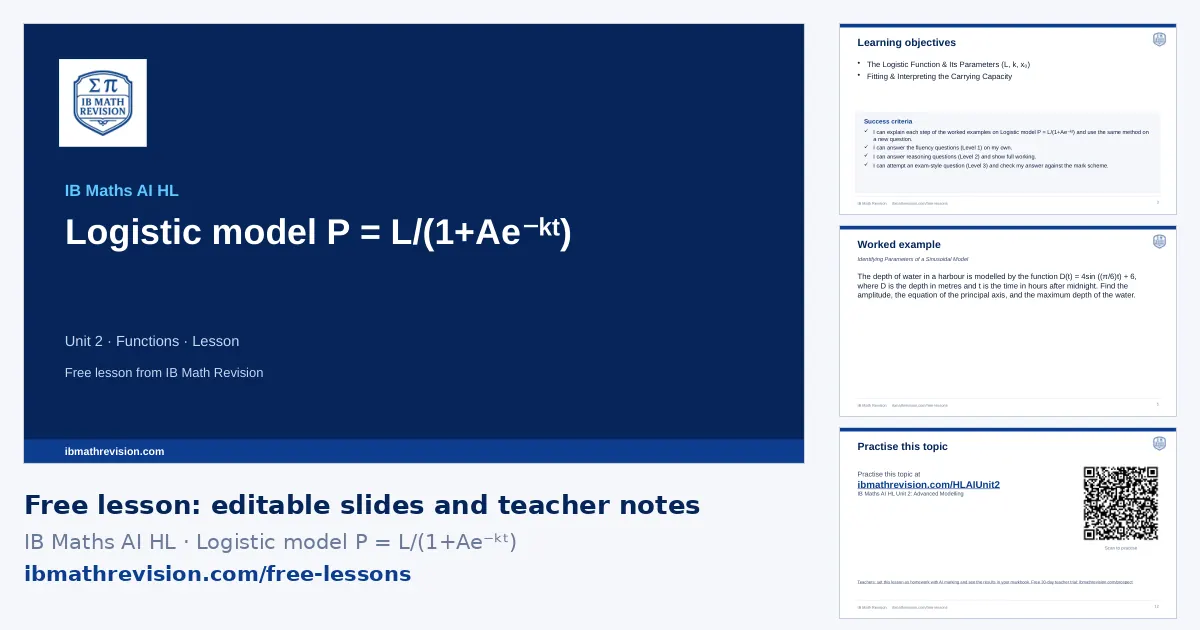
- Slides (PowerPoint, editable) · freeabout 12 slides: do now, objectives, key ideas, a worked example step by step, “your turn”, practice QR code, exit ticket
- Teacher notes (PDF) · freelesson plan with timings, common mistakes, homework links
- Worksheet (PDF) · school plans6 questions, 33 marks: Fluency, Reasoning, Exam-style. Included with school plans and the teacher trial.
- Answers (PDF) · school plansthe answer to every worksheet question, from its mark scheme. Included with school plans and the teacher trial.
Learning objectives
- The Logistic Function & Its Parameters (L, k, x₀)
- Fitting & Interpreting the Carrying Capacity
Key ideas on the slides
- The logistic model f(x) = L/(1 + Ce⁻ᵏˣ) (L, C, k > 0) models growth that levels off.
- L is the carrying capacity: the horizontal asymptote y = L and the long-term value.
- The initial value is f(0) = L/(1 + C); growth is fastest when f(x) = L/2.
- Fit with logistic regression on the GDC; solve f(x) = value graphically.
By the end of the lesson, students should be able to answer a question like: Find the carrying capacity for the model P(t) = 1000 / (1+9e−0.2t).
Key vocabulary
- logistic model: A growth model that starts almost exponentially and levels off at a limit.
- carrying capacity: The maximum value L the model approaches.
- point of inflection: Where the growth rate is greatest (at y = L/2).
Common mistakes this lesson tackles
- Modelling: regression on the GDC, r² for non-linear models, context of the variable. Use the GDC's regression for the model named. Compare non-linear fits with R² and quote both values. Define the variable ("t = years after 2010") before substituting, and answer the comparison the question actually asks.
- Thinking the model eventually passes L.
- Reading C as the initial value.
- Using exponential growth for data that level off.
The worked example
The depth of water in a harbour is modelled by the function D(t) = 4sin ((π/6)t) + 6, where D is the depth in metres and t is the time in hours after midnight. Find the amplitude, the equation of the principal axis, and the maximum depth of the water.
- Identify the amplitude from the coefficient of the sine function: a = 4.
- Identify the principal axis from the vertical shift: y = 6.
- Calculate the maximum depth by adding the amplitude to the principal axis: 6 + 4.
- The maximum depth is 10 m.
Tip: When extracting parameters from trigonometric models, remember that the amplitude is always a positive distance. The maximum value is simply the principal axis plus the amplitude.
Calculator tips
- Graph the model and use intersect for "when does it reach …" questions.
Where this lesson fits
Logistic model P = L/(1+Ae⁻ᵏᵗ) is in Unit 2 · Functions of the IB Maths AI HL scheme of work.
- The lesson before: Log-transformed regression (scheme-of-work lessons: Linearizing Data with Log-Log & Semi-Log Scales; Linearising y = axᵇ and y = abˣ)
- The next lesson: Vertical + horizontal shifts (scheme-of-work lessons: Transformations of graphs)
Lesson plan
| 0–5 min | Do now: students write down what they remember about Log-transformed regression and Exponential decay models |
| 5–8 min | Share the learning objective and success criteria |
| 8–20 min | Teach: the worked example, step by step; students copy the method |
| 20–25 min | Your turn: 1 mini-whiteboard question; check every board before moving on |
| 25–42 min | Practise: the worksheet (6 questions in 3 levels, with school plans and the teacher trial) or the topic's practice questions online; move up a level after two right in a row |
| 42–47 min | Plenary: 1-question exit ticket; collect it to plan the next lesson |
For students: practise this topic
The worksheet's QR code opens the IB Maths AI HL Unit 2: Advanced Modelling practice questions.
With a school plan
Set Logistic model P = L/(1+Ae⁻ᵏᵗ) as homework marked by AI, print this lesson's levelled worksheet with answers, and rebuild the lesson for your class with Create lesson. Free for 30 days as a teacher, no card.
Is it free, can I edit the slides, what do students use for homework? See questions teachers ask.