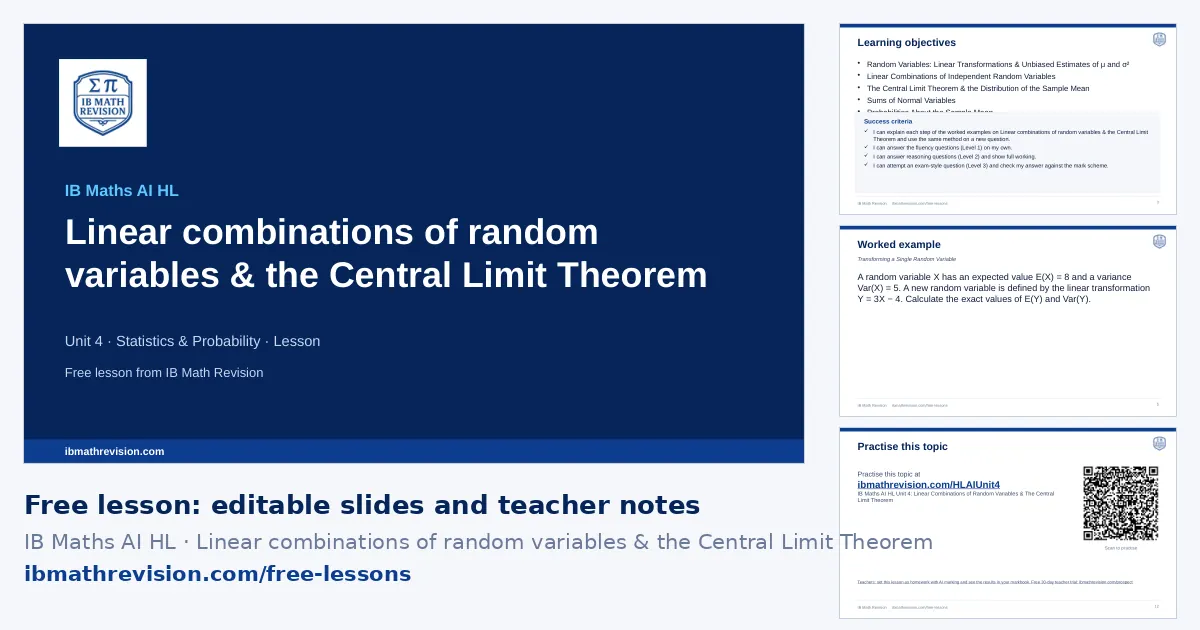
Free IB Maths AI HL lesson: Linear combinations of random variables & the Central Limit Theorem
A ready-to-teach IB Maths AI HL lesson on Linear combinations of random variables & the Central Limit Theorem (Unit 4 · Statistics & Probability): editable slides and teacher notes, free; a printable worksheet in 3 levels with answers for school plans. About 55 minutes.
Free with a teacher account. Sign in with Google, Microsoft or email and download the slides and teacher notes.
What's inside
- Slides (PowerPoint, editable) · freeabout 12 slides: do now, objectives, key ideas, a worked example step by step, “your turn”, practice QR code, exit ticket
- Teacher notes (PDF) · freelesson plan with timings, common mistakes, homework links
- Worksheet (PDF) · school plans6 questions, 28 marks: Fluency, Reasoning, Exam-style. Included with school plans and the teacher trial.
- Answers (PDF) · school plansthe answer to every worksheet question, from its mark scheme. Included with school plans and the teacher trial.
Learning objectives
- Random Variables: Linear Transformations & Unbiased Estimates of μ and σ²
- Linear Combinations of Independent Random Variables
- The Central Limit Theorem & the Distribution of the Sample Mean
- Sums of Normal Variables
- Probabilities About the Sample Mean
Key ideas on the slides
- E(aX + b) = aE(X) + b and Var(aX + b) = a²Var(X).
- For independent X and Y: E(X ± Y) = E(X) ± E(Y) and Var(X ± Y) = Var(X) + Var(Y) (variances always add).
- X₁ + X₂ (two independent copies) has variance 2Var(X), but 2X has variance 4Var(X).
- Unbiased estimate of σ²: sₙ₋₁² = (n/(n − 1))sₙ².
By the end of the lesson, students should be able to answer a question like: Find the mean and variance of F = 3.5 + 1.8D when E(D) = 12 and Var(D) = 16.
Skills in this topic
Linear combinations of random variables & the Central Limit Theorem breaks down into 3 skills. In the worksheet builder, teachers can set practice on just one of them.
- E(aX + b) and Var(aX + b)
- Sums & differences of independent variables
- The Central Limit Theorem
Key vocabulary
- linear combination: A sum such as aX + bY.
- unbiased estimator: A statistic whose expected value equals the parameter.
- variance: The expected squared distance from the mean.
- sampling distribution: The distribution of a statistic over all possible samples.
- Central Limit Theorem: The sample mean is approximately normal for large samples.
Common mistakes this lesson tackles
- Distributions: variances add, the normal is continuous, the binomial coefficient. For independent X and Y: Var(X ± Y) = Var(X) + Var(Y); Var(aX) = a²Var(X). State the final distribution, e.g. X − Y ~ N(20, 25), before finding probabilities.
- Hypothesis tests: hypotheses in words, the wrong test, and conclusions that don't follow. Write H₀ and H₁ with symbols for population parameters (μ, ρ, p). Choose the test from the design (paired data → paired t; σ unknown → t). State the p-value, compare it with the stated significance level, then conclude in context. For goodness of fit: df = cells − 1 − parameters estimated.
- Writing Var(aX + b) = aVar(X) + b.
- Subtracting variances for X − Y.
The worked example
A random variable X has an expected value E(X) = 8 and a variance Var(X) = 5. A new random variable is defined by the linear transformation Y = 3X − 4. Calculate the exact values of E(Y) and Var(Y).
- Identify the rule for expected values: E(aX + b) = aE(X) + b.
- Calculate E(Y): E(3X − 4) = 3(8) − 4 = 24 − 4 = 20.
- Identify the rule for variance: Var(aX + b) = a²Var(X). (Note that the shift −4 does not affect the spread).
- Calculate Var(Y): Var(3X − 4) = 3²(5) = 9 × 5 = 45.
Tip: A common error is subtracting the constant b from the variance. Remember that shifting a dataset left or right does absolutely nothing to its variance or standard deviation.
Calculator tips
- No GDC step: write the rule you use.
- ZInterval or TInterval on the GDC.
Where this lesson fits
Linear combinations of random variables & the Central Limit Theorem is in Unit 4 · Statistics & Probability of the IB Maths AI HL scheme of work.
- The lesson before: Full hypothesis test — H0/H1, p-value, conclusion (scheme-of-work lessons: Tests for a Population Mean (z and t); Tests for a Binomial Proportion & a Poisson Mean; Testing Correlation (H₀: ρ = 0))
- The next lesson: Discrete random variables & expected value (scheme-of-work lessons: Probability Distributions & E(X); Cumulative Probabilities & Expected Values)
Lesson plan
| 0–5 min | Do now: students write down what they remember about Sampling techniques & data collection and Full hypothesis test — H0/H1, p-value, conclusion |
| 5–8 min | Share the learning objective and success criteria |
| 8–20 min | Teach: the worked example, step by step; students copy the method |
| 20–25 min | Your turn: 1 mini-whiteboard question; check every board before moving on |
| 25–42 min | Practise: the worksheet (6 questions in 3 levels, with school plans and the teacher trial) or the topic's practice questions online; move up a level after two right in a row |
| 42–47 min | Plenary: 1-question exit ticket; collect it to plan the next lesson |
For students: practise this topic
The worksheet's QR code opens the IB Maths AI HL Unit 4: Linear Combinations of Random Variables & The Central Limit Theorem practice questions.
With a school plan
Set Linear combinations of random variables & the Central Limit Theorem as homework marked by AI, print this lesson's levelled worksheet with answers, and rebuild the lesson for your class with Create lesson. Free for 30 days as a teacher, no card.
Is it free, can I edit the slides, what do students use for homework? See questions teachers ask.