Free IB Maths AI HL lesson: Kinematics: displacement, velocity & acceleration
A ready-to-teach IB Maths AI HL lesson on Kinematics: displacement, velocity & acceleration (Unit 5 · Calculus): editable slides and teacher notes, free; a printable worksheet in 3 levels with answers for school plans. About 55 minutes.
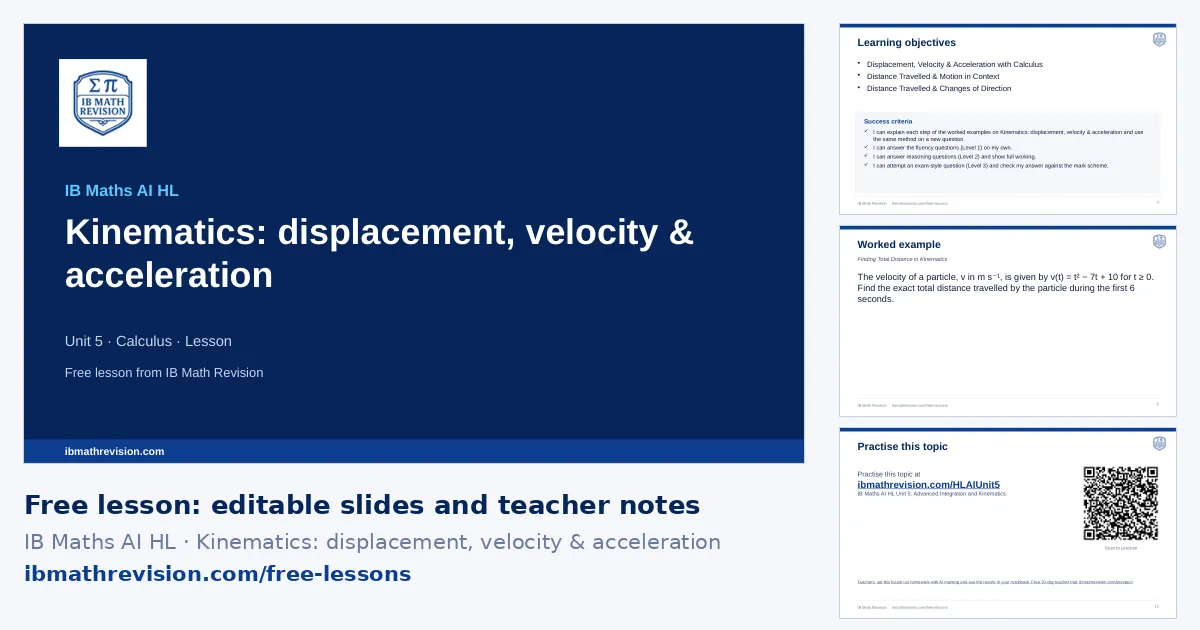
Free with a teacher account. Sign in with Google, Microsoft or email and download the slides and teacher notes.
What's inside
- Slides (PowerPoint, editable) · freeabout 12 slides: do now, objectives, key ideas, a worked example step by step, “your turn”, practice QR code, exit ticket
- Teacher notes (PDF) · freelesson plan with timings, common mistakes, homework links
- Worksheet (PDF) · school plans6 questions, 32 marks: Fluency, Reasoning, Exam-style. Included with school plans and the teacher trial.
- Answers (PDF) · school plansthe answer to every worksheet question, from its mark scheme. Included with school plans and the teacher trial.
Learning objectives
- Displacement, Velocity & Acceleration with Calculus
- Distance Travelled & Motion in Context
- Changes of Direction & Motion in a Plane
Key ideas on the slides
- Velocity v = ds/dt; acceleration a = dv/dt = d²s/dt².
- Displacement from velocity: s = ∫ v dt (find C from the initial position); change in displacement = ∫_t₁^(t₂) v dt.
- Distance travelled = ∫_t₁^(t₂) |v| dt: split where v = 0 (where the particle changes direction).
- Speed is |v|; the particle is at rest when v = 0.
By the end of the lesson, students should be able to answer a question like: Find the distance travelled in the first 4 seconds when v(t) = t2 − 4t.
Key vocabulary
- displacement: Position relative to a fixed origin, with a sign for direction.
- velocity: The rate of change of displacement.
- speed: The magnitude of velocity.
Common mistakes this lesson tackles
- Using ∫ v dt for distance when the particle changes direction.
- Using suvat when the acceleration is not constant.
- Confusing speed and velocity (signs).
The worked example
The velocity of a particle, v in m s⁻¹, is given by v(t) = t² − 7t + 10 for t ≥ 0. Find the exact total distance travelled by the particle during the first 6 seconds.
- Identify when the particle is momentarily at rest by setting v(t) = 0: t² − 7t + 10 = 0 ⇒ (t−2)(t−5) = 0. The particle rests at t=2 and t=5.
- Recognize that the velocity is negative between t=2 and t=5, meaning the particle moves backwards. Total distance requires the absolute value of velocity.
- Set up the total distance integral, splitting at the sign changes: D = ∫₀² v dt − ∫₂⁵ v dt + ∫₅⁶ v dt.
- Evaluate using the antiderivative F(t) = t³/3 − 7t²/2 + 10t: the three segments give 26/3, 9/2, and 11/6 respectively.
- Sum the three positive contributions: 26/3 + 9/2 + 11/6 = (52 + 27 + 11)/6 = 90/6 = 15.
- The total distance travelled is exactly 15 m.
Tip: Displacement is ∫ v(t) dt, whereas Total Distance is ∫ |v(t)| dt. Forgetting the absolute value signs will wrongly subtract the backwards movement from the total.
Calculator tips
- Integrate |v| with the GDC for distance; graph v to see where it changes sign.
Where this lesson fits
Kinematics: displacement, velocity & acceleration is in Unit 5 · Calculus of the IB Maths AI HL scheme of work.
- The lesson before: Second derivative, concavity & points of inflexion (scheme-of-work lessons: Second derivative, concavity and points of inflection)
- The next lesson: Related rates of change (scheme-of-work lessons: Related (connected) rates of change)
Lesson plan
| 0–5 min | Do now: students write down what they remember about Second derivative, concavity & points of inflexion and Volumes of revolution |
| 5–8 min | Share the learning objective and success criteria |
| 8–20 min | Teach: the worked example, step by step; students copy the method |
| 20–25 min | Your turn: 1 mini-whiteboard question; check every board before moving on |
| 25–42 min | Practise: the worksheet (6 questions in 3 levels, with school plans and the teacher trial) or the topic's practice questions online; move up a level after two right in a row |
| 42–47 min | Plenary: 1-question exit ticket; collect it to plan the next lesson |
For students: practise this topic
The worksheet's QR code opens the IB Maths AI HL Unit 5: Advanced Integration and Kinematics practice questions.
With a school plan
Set Kinematics: displacement, velocity & acceleration as homework marked by AI, print this lesson's levelled worksheet with answers, and rebuild the lesson for your class with Create lesson. Free for 30 days as a teacher, no card.
Is it free, can I edit the slides, what do students use for homework? See questions teachers ask.