Free IB Maths AA SL lesson: Rounding, estimation & standard form
A ready-to-teach IB Maths AA SL lesson on Rounding, estimation & standard form (Unit 0 · Prior knowledge): editable slides and teacher notes, free; a printable worksheet in 3 levels with answers for school plans. About 55 minutes.
Free with a teacher account. Sign in with Google, Microsoft or email and download the slides and teacher notes.
What's inside
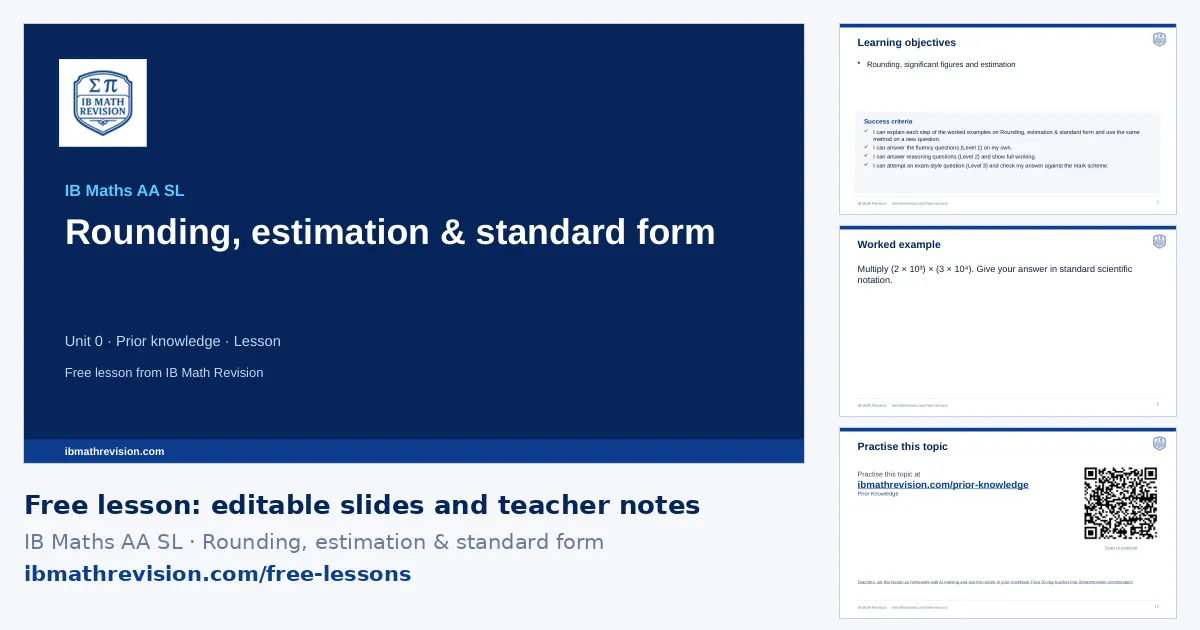
- Slides (PowerPoint, editable) · freeabout 12 slides: do now, objectives, key ideas, a worked example step by step, “your turn”, practice QR code, exit ticket
- Teacher notes (PDF) · freelesson plan with timings, common mistakes, homework links
- Worksheet (PDF) · school plans6 questions, 26 marks: Fluency, Reasoning, Exam-style. Included with school plans and the teacher trial.
- Answers (PDF) · school plansthe answer to every worksheet question, from its mark scheme. Included with school plans and the teacher trial.
Learning objectives
- Rounding, significant figures and estimation
Key vocabulary
- significant figure: A digit that carries meaning, counted from the first non-zero digit.
- decimal place: A digit position after the decimal point.
- estimate: An approximate answer found by rounding the numbers first.
- standard form: A number written as A × 10ⁿ with 1 ≤ A < 10.
- power of ten: The index n in 10ⁿ: how many places the digits move.
Common mistakes this lesson tackles
- Accuracy: 2 s.f. answers, early rounding and ignored accuracy instructions. Keep full calculator values (store them) until the very last line. Give final answers exactly or to 3 s.f. unless the question says otherwise, and when a given answer has more figures, show your value to more figures than that before rounding.
- Dropping place-holding zeros when rounding a large number: 48 260 to 2 s.f. is not 48.
- Counting the leading zeros of 0.00473 as significant figures.
Lesson plan
| 0–5 min | Do now: students write down what they remember about Ratio & proportion and Fractions, decimals & percentages |
| 5–8 min | Share the learning objective and success criteria |
| 8–20 min | Teach: the worked example, step by step; students copy the method |
| 20–25 min | Your turn: 1 mini-whiteboard question; check every board before moving on |
| 25–42 min | Practise: the worksheet (6 questions in 3 levels, with school plans and the teacher trial) or the topic's practice questions online; move up a level after two right in a row |
| 42–47 min | Plenary: 1-question exit ticket; collect it to plan the next lesson |
For students: practise this topic
The worksheet's QR code opens the Prior Knowledge practice questions.
What schools get
- Set this lesson as homework, marked by AI against the mark scheme, with every result in your markbook (school Pro plan).
- This lesson's worksheet in three levels, with its answers, ready to print.
- Support, Core and Stretch versions and A/B copies of the worksheet from the full question bank, in the worksheet builder.
- Create lesson: this lesson rebuilt for your class's next scheme-of-work lesson, from the full bank.
School licences from €490 a year. Try everything free for 30 days as a teacher: no card.
Questions teachers ask
Is this lesson free?
The slides and the teacher notes are free to download with a free IB Math Revision teacher account (sign in with Google, Microsoft or email); no card. The printable worksheet in three levels and its answers are included with school plans and the free 30-day teacher trial.
Can I edit the slides?
Yes. The slides are an ordinary PowerPoint file: change, add or delete anything. They also open in Google Slides and Keynote. The logo and web address sit on the slide master, so your edits do not move them.
What do students use for homework?
The practice slide's QR code and web address take students to the Prior Knowledge practice questions on ibmathrevision.com, where the free questions are open and the full bank comes with a plan.