Free IB Maths AA SL and AI SL lesson: Pythagoras & right-angle trig (SOH-CAH-TOA)
A ready-to-teach IB Maths AA SL and AI SL lesson on Pythagoras & right-angle trig (SOH-CAH-TOA): editable slides and teacher notes, free; a printable worksheet in 3 levels with answers for school plans. About 55 minutes.
Free with a teacher account. Sign in with Google, Microsoft or email and download the slides and teacher notes.
One lesson for AA SL and AI SL
Pythagoras & right-angle trig (SOH-CAH-TOA) is taught in IB Maths AA SL and IB Maths AI SL, with the same key ideas. Choose your course above the download button: each version's slides use that course's own worked example, questions and practice link.
- AA SL (Unit 0 · Prior knowledge)
- AI SL (Unit 0 · Prior knowledge)
What's inside
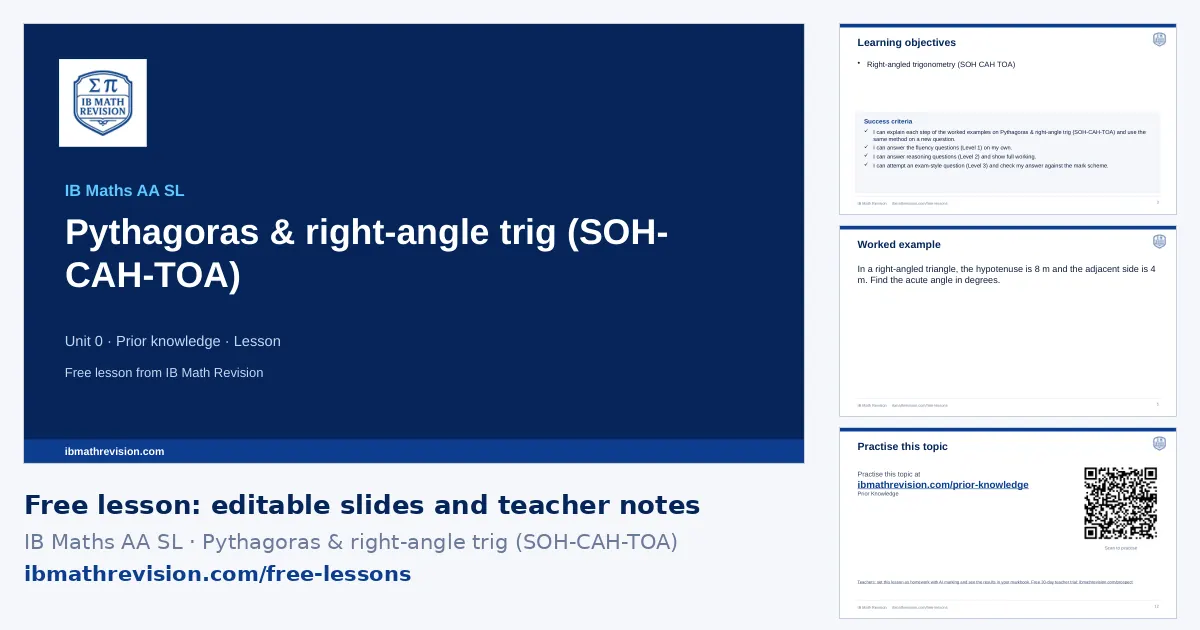
- Slides (PowerPoint, editable) · freeabout 12 slides: do now, objectives, key ideas, a worked example step by step, “your turn”, practice QR code, exit ticket
- Teacher notes (PDF) · freelesson plan with timings, common mistakes, homework links
- Worksheet (PDF) · school plans6 questions, 18 marks: Fluency, Reasoning, Exam-style. Included with school plans and the teacher trial.
- Answers (PDF) · school plansthe answer to every worksheet question, from its mark scheme. Included with school plans and the teacher trial.
Learning objectives
- Right-angled trigonometry (SOH CAH TOA)
Key ideas on the slides
- sin θ = opp/hyp, cos θ = adj/hyp, tan θ = opp/adj.
- Label the sides from the angle you are using: hypotenuse, opposite, adjacent; then choose the ratio with the two sides you have or want.
- Finding a side: x = 12sin 35° or x = 12/(tan 35°). Finding an angle: use the inverse, θ = sin⁻¹(⅝).
- The angle of elevation is measured up from the horizontal; the angle of depression is measured down from the horizontal (and equals the elevation from the other point).
By the end of the lesson, students should be able to answer a question like: Find the hypotenuse when the two shorter sides are 6 and 8.
Key vocabulary
- hypotenuse: The side opposite the right angle.
- opposite: The side across from the angle being used.
- adjacent: The side next to the angle being used (not the hypotenuse).
- angle of elevation: The angle up from the horizontal to an object.
- right-angled triangle: A triangle with one angle of 90°.
Common mistakes this lesson tackles
- Labelling opposite and adjacent from the wrong angle.
- Calculator in radians (or gradians) instead of degrees.
- Multiplying instead of dividing when the unknown side is in the denominator.
- Adding the squares when finding a shorter side.
Calculator tips
- Check the D (degrees) symbol is on the display before any trigonometry.
- Type the whole calculation: √((6.5² − 6²)).
Where this lesson fits
Pythagoras & right-angle trig (SOH-CAH-TOA) is in Unit 0 · Prior knowledge of the IB Maths AA SL scheme of work.
- The lesson before: Perimeter, area & volume (scheme-of-work lessons: Perimeter and area)
- The next lesson: Averages & basic data handling (scheme-of-work lessons: Summary statistics: averages and spread)
Lesson plan
| 0–5 min | Do now: students write down what they remember about Perimeter, area & volume and Coordinates & straight-line basics |
| 5–8 min | Share the learning objective and success criteria |
| 8–20 min | Teach: the worked example, step by step; students copy the method |
| 20–25 min | Your turn: 1 mini-whiteboard question; check every board before moving on |
| 25–42 min | Practise: the worksheet (6 questions in 3 levels, with school plans and the teacher trial) or the topic's practice questions online; move up a level after two right in a row |
| 42–47 min | Plenary: 1-question exit ticket; collect it to plan the next lesson |
For students: practise this topic
The worksheet's QR code opens your course's practice questions:
With a school plan
Set Pythagoras & right-angle trig (SOH-CAH-TOA) as homework marked by AI, print this lesson's levelled worksheet with answers, and rebuild the lesson for your class with Create lesson. Free for 30 days as a teacher, no card.
Is it free, can I edit the slides, what do students use for homework? See questions teachers ask.