Free IB Maths AA SL and AI HL lesson: Optimisation in context
A ready-to-teach IB Maths AA SL and AI HL lesson on Optimisation in context: editable slides and teacher notes, free; a printable worksheet in 3 levels with answers for school plans. About 55 minutes.
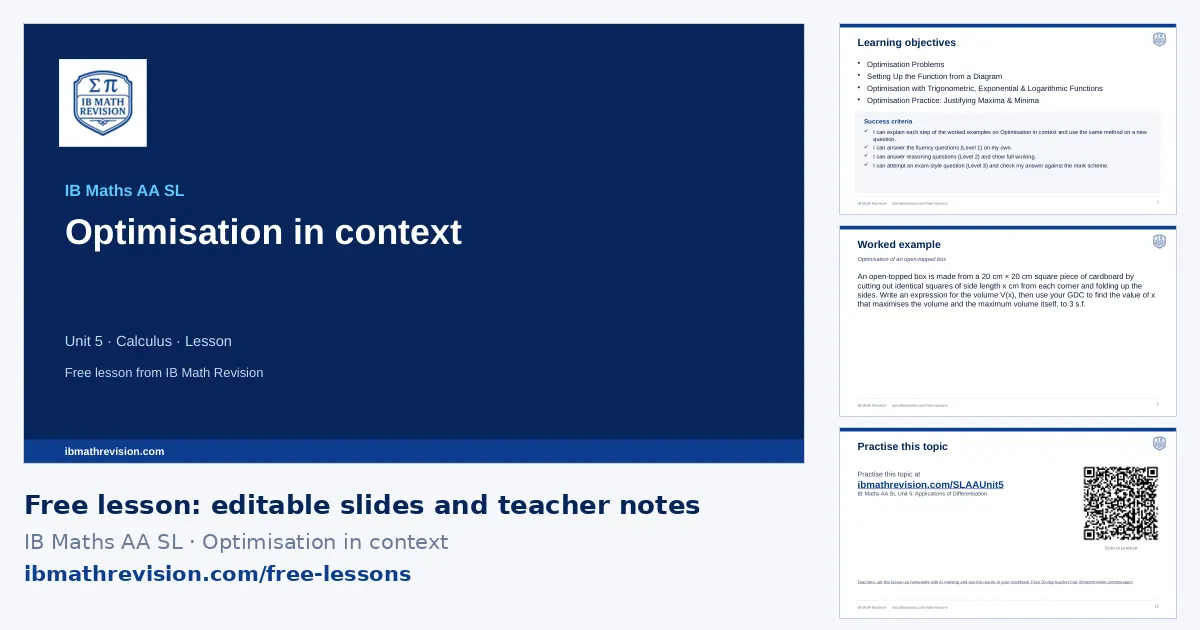
Free with a teacher account. Sign in with Google, Microsoft or email and download the slides and teacher notes.
One lesson for AA SL and AI HL
Optimisation in context is taught in IB Maths AA SL and IB Maths AI HL, with the same key ideas. Choose your course above the download button: each version's slides use that course's own worked example, questions and practice link.
- AA SL (Unit 5 · Calculus): Optimisation Problems; Setting Up the Function from a Diagram; Optimisation with Trigonometric, Exponential & Logarithmic Functions; Optimisation Practice: Justifying Maxima & Minima
- AI HL (Unit 5 · Calculus): Optimisation
What's inside
- Slides (PowerPoint, editable) · freeabout 12 slides: do now, objectives, key ideas, a worked example step by step, “your turn”, practice QR code, exit ticket
- Teacher notes (PDF) · freelesson plan with timings, common mistakes, homework links
- Worksheet (PDF) · school plans5 questions, 32 marks: Fluency, Reasoning, Exam-style. Included with school plans and the teacher trial.
- Answers (PDF) · school plansthe answer to every worksheet question, from its mark scheme. Included with school plans and the teacher trial.
Learning objectives (AA SL)
- Optimisation Problems
- Setting Up the Function from a Diagram
- Optimisation with Trigonometric, Exponential & Logarithmic Functions
- Optimisation Practice: Justifying Maxima & Minima
Key ideas on the slides
- Write the quantity to be optimised as a function of one variable, using the constraint to eliminate the other.
- Differentiate, set the derivative to 0 and solve.
- Show it is a maximum or minimum (second derivative or sign change), and check the end points of the domain.
- Answer the question asked, with units: the maximum volume, or the dimensions that give it.
By the end of the lesson, students should be able to answer a question like: Find the dimensions that maximize the volume of a cylindrical can.
Skills in this topic
Optimisation in context breaks down into 4 skills. In the worksheet builder, teachers can set practice on just one of them.
- Fencing & rectangle problems: Write an area in one variable using a fixed perimeter, then maximise it.
- Open boxes from a sheet: Cut squares from the corners of a sheet, write the volume and find the largest one.
- Cylinders with a fixed volume: Use the fixed volume to write the surface area in r, then minimise it.
- Shortest distance & minimum value: Minimise a distance to a curve or a given function with calculus.
Key vocabulary
- optimise: Find the maximum or minimum value of a quantity.
- constraint: A condition linking the variables (such as a fixed perimeter).
- domain: The values of the variable that make sense in context.
Common mistakes this lesson tackles
- Modelling in context: not setting up the expression, and answers that ignore the context. Translate the words first: fastest rate means maximise the derivative; closest means minimise a distance. End with a sentence in the units and form the context needs (a year, a whole number, one value).
- Differentiating before writing the quantity in one variable.
- Not justifying that the value is a maximum or minimum.
- Giving x when the question asks for the maximum value.
The worked example
An open-topped box is made from a 20 cm × 20 cm square piece of cardboard by cutting out identical squares of side length x cm from each corner and folding up the sides. Write an expression for the volume V(x), then use your GDC to find the value of x that maximises the volume and the maximum volume itself, to 3 s.f.
- Determine the folded dimensions: base is (20 − 2x) by (20 − 2x), height is x.
- Construct the volume function: V(x) = x(20 − 2x)².
- Identify the practical domain: x > 0 and 20 − 2x > 0, so 0 < x < 10.
- Graph V(x) on the GDC (CG50: MENU 5, Y1 = x(20 - 2x)^2).
- Use the maximum tool (G-Solv → MAX) on the valid domain.
- State: x = 3.33 cm (3 s.f.) and maximum volume 593 cm³ (3 s.f.).
Tip: In Paper 2 optimisation questions do NOT differentiate manually unless the question says "Use calculus to...". Graph and use G-Solv — much faster with less risk of algebra error.
Calculator tips
- Graph the function over its domain and use maximum to check.
Where this lesson fits
Optimisation in context is in Unit 5 · Calculus of the IB Maths AA SL scheme of work.
- The lesson before: Tangents & normals at a point (scheme-of-work lessons: Tangents & Normals; The Point with a Given Gradient; Combining the Rules — Tangents & Normals to Standard Functions)
- The next lesson: Antiderivatives (integration) (scheme-of-work lessons: Reversing Differentiation (Indefinite Integrals); Finding the Constant of Integration; Antiderivatives in Context: f(x) from f′(x) & a Point)
Lesson plan
| 0–5 min | Do now: students write down what they remember about Stationary points & classification and Tangents & normals at a point |
| 5–8 min | Share the learning objective and success criteria |
| 8–20 min | Teach: the worked example, step by step; students copy the method |
| 20–25 min | Your turn: 1 mini-whiteboard question; check every board before moving on |
| 25–42 min | Practise: the worksheet (5 questions in 3 levels, with school plans and the teacher trial) or the topic's practice questions online; move up a level after two right in a row |
| 42–47 min | Plenary: 1-question exit ticket; collect it to plan the next lesson |
For students: practise this topic
The worksheet's QR code opens your course's practice questions:
- IB Maths AA SL Unit 5: Applications of Differentiation practice questions
- IB Maths AI HL Unit 5: Optimisation practice questions
With a school plan
Set Optimisation in context as homework marked by AI, print this lesson's levelled worksheet with answers, and rebuild the lesson for your class with Create lesson. Free for 30 days as a teacher, no card.
Is it free, can I edit the slides, what do students use for homework? See questions teachers ask.