Free IB Maths AA SL and AI SL lesson: Number operations & order of operations (BIDMAS)
A ready-to-teach IB Maths AA SL and AI SL lesson on Number operations & order of operations (BIDMAS): editable slides and teacher notes, free; a printable worksheet in 3 levels with answers for school plans. About 55 minutes.
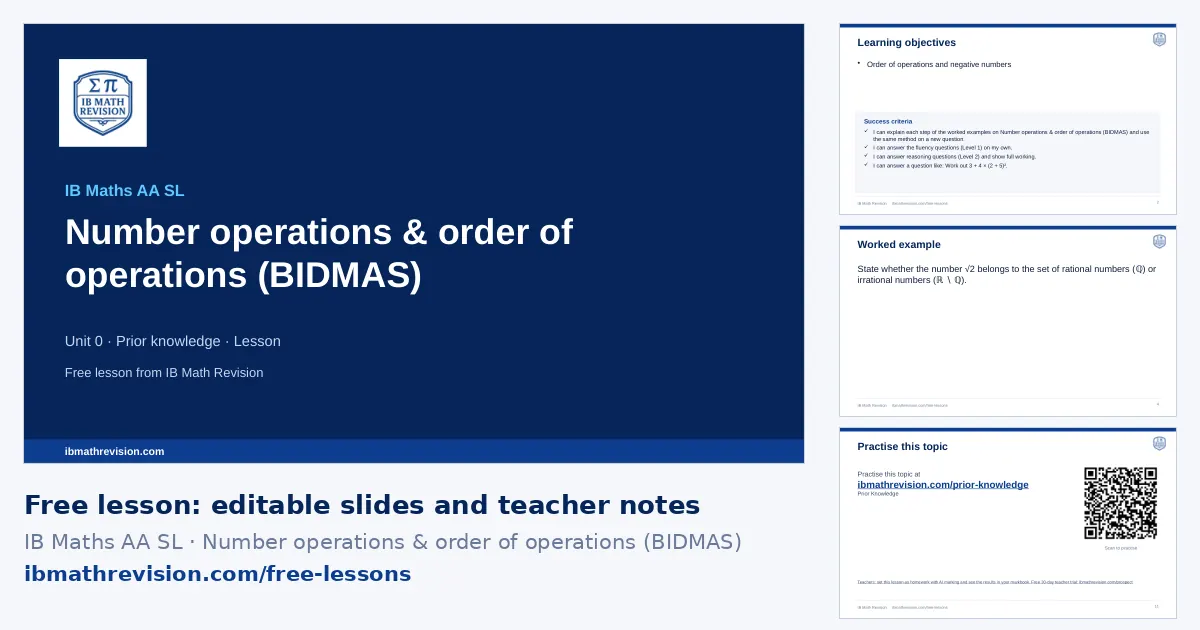
Free with a teacher account. Sign in with Google, Microsoft or email and download the slides and teacher notes.
One lesson for AA SL and AI SL
Number operations & order of operations (BIDMAS) is taught in IB Maths AA SL and IB Maths AI SL, with the same key ideas. Choose your course above the download button: each version's slides use that course's own worked example, questions and practice link.
- AA SL (Unit 0 · Prior knowledge)
- AI SL (Unit 0 · Prior knowledge)
What's inside
- Slides (PowerPoint, editable) · freeabout 11 slides: objectives, key ideas, a worked example step by step, “your turn”, practice QR code, exit ticket
- Teacher notes (PDF) · freelesson plan with timings, common mistakes, homework links
- Worksheet (PDF) · school plans6 questions, 18 marks: Fluency, Reasoning, Exam-style. Included with school plans and the teacher trial.
- Answers (PDF) · school plansthe answer to every worksheet question, from its mark scheme. Included with school plans and the teacher trial.
Learning objectives
- Order of operations and negative numbers
Key ideas on the slides
- Work in this order: Brackets, then Indices (powers and roots), then Division and Multiplication from left to right, then Addition and Subtraction from left to right.
- Division and multiplication have equal priority, so work left to right: 12 ÷ 3 × 2 = 4 × 2 = 8, not 12 ÷ 6 = 2.
- A fraction bar groups everything above it and everything below it: (6+4)/2 = 5, so type brackets round the numerator and denominator on a calculator.
- With negatives: same signs give a positive product or quotient, different signs give a negative one: (−3)×(−4)=12, (−12)÷ 4=−3.
By the end of the lesson, students should be able to answer a question like: Work out 3 + 4 × (2 + 5)2.
Key vocabulary
- operation: A calculation done on numbers: add, subtract, multiply, divide, power or root.
- integer: A whole number, positive, negative or zero.
- priority: Which operation is carried out first when there is more than one.
Common mistakes this lesson tackles
- Working strictly left to right and ignoring the order: 2+3×4 is 14, not 20.
- Thinking multiplication always comes before division (the "M before D" reading of BIDMAS): they have equal priority.
- Typing −3² into a calculator and expecting 9: the square is done before the negative sign.
Calculator tips
- Use the fraction key or type brackets round a whole numerator and denominator; check the answer with a rough estimate.
Where this lesson fits
Number operations & order of operations (BIDMAS) is in Unit 0 · Prior knowledge of the IB Maths AA SL scheme of work.
- The next lesson: Fractions, decimals & percentages (scheme-of-work lessons: Fractions, decimals and percentages)
Lesson plan
| 0–5 min | Do now: students write down what they remember from last lesson |
| 5–8 min | Share the learning objective and success criteria |
| 8–20 min | Teach: the worked example, step by step; students copy the method |
| 20–25 min | Your turn: 1 mini-whiteboard question; check every board before moving on |
| 25–42 min | Practise: the worksheet (6 questions in 3 levels, with school plans and the teacher trial) or the topic's practice questions online; move up a level after two right in a row |
| 42–47 min | Plenary: 1-question exit ticket; collect it to plan the next lesson |
For students: practise this topic
The worksheet's QR code opens your course's practice questions:
With a school plan
Set Number operations & order of operations (BIDMAS) as homework marked by AI, print this lesson's levelled worksheet with answers, and rebuild the lesson for your class with Create lesson. Free for 30 days as a teacher, no card.
Is it free, can I edit the slides, what do students use for homework? See questions teachers ask.