Free IB Maths AA SL lesson: Natural logs & change of base
A ready-to-teach IB Maths AA SL lesson on Natural logs & change of base (Unit 1 · Number & Algebra): editable slides and teacher notes, free; a printable worksheet in 3 levels with answers for school plans. About 55 minutes.
Free with a teacher account. Sign in with Google, Microsoft or email and download the slides and teacher notes.
What's inside
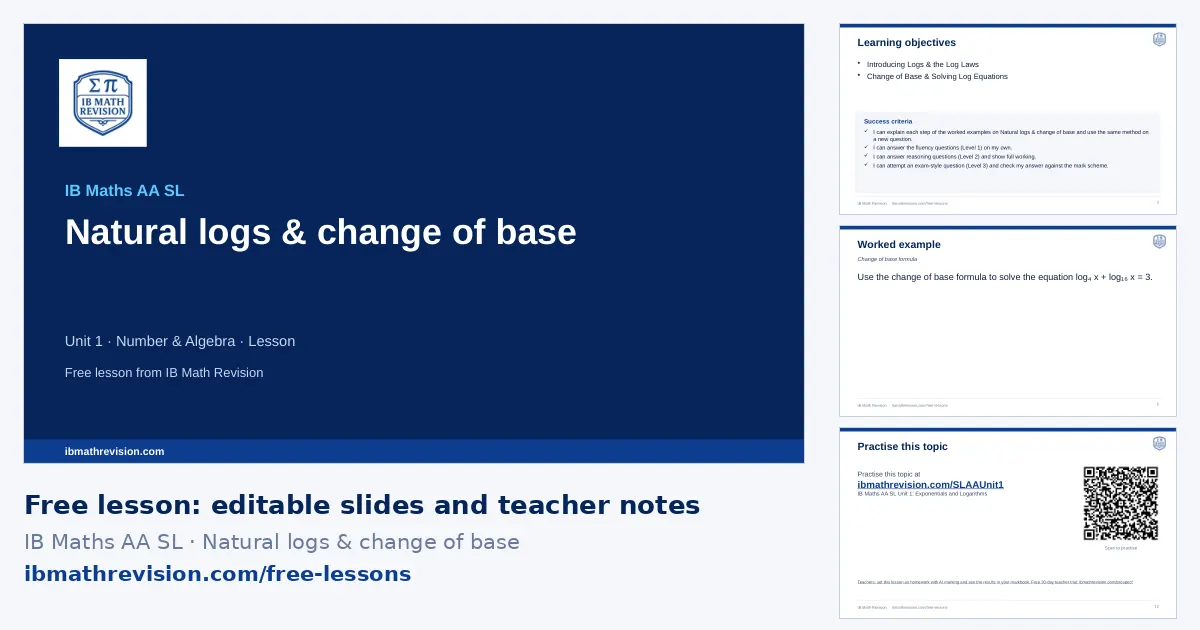
- Slides (PowerPoint, editable) · freeabout 12 slides: do now, objectives, key ideas, a worked example step by step, “your turn”, practice QR code, exit ticket
- Teacher notes (PDF) · freelesson plan with timings, common mistakes, homework links
- Worksheet (PDF) · school plans6 questions, 27 marks: Fluency, Reasoning, Exam-style. Included with school plans and the teacher trial.
- Answers (PDF) · school plansthe answer to every worksheet question, from its mark scheme. Included with school plans and the teacher trial.
Learning objectives
- Introducing Logs & the Log Laws
- Change of Base & Solving Log Equations
Key ideas on the slides
- logₐ b = x ⇔ aˣ = b (with a > 0, a ≠ 1, b > 0); ln x = logₑ x.
- Laws: logₐ(xy) = logₐ x + logₐ y, logₐ(x/y) = logₐ x − logₐ y, logₐ xᵏ = klogₐ x.
- logₐ a = 1, logₐ 1 = 0, a^(logₐ x) = x; change of base: logₐ b = (log_c b)/(log_c a).
- Solve aˣ = b by taking logs: x = (ln b)/(ln a); solve a log equation by combining into one log, then removing it: log₂ A = 3 ⇒ A = 2³.
By the end of the lesson, students should be able to answer a question like: Express log₄(x) in terms of the natural logarithm ln(x).
Key vocabulary
- logarithm: logₐ b is the power a must be raised to to give b.
- natural logarithm: ln x, the logarithm to base e.
- argument: The input of the log function, which must be positive.
Common mistakes this lesson tackles
- log(a + b) = log a + log b (false: logs split products, not sums).
- (log a)/(log b) = log a − log b (false: that is log a/b).
- Keeping a root that makes a log's argument negative.
The worked example
Use the change of base formula to solve the equation log₄ x + log₁₆ x = 3.
- Apply the change of base formula to express log₁₆ x in base 4: log₁₆ x = (log₄ x)/(log₄ 16).
- Evaluate the denominator since 4² = 16: log₄ 16 = 2.
- Substitute this back into the original equation: log₄ x + (log₄ x)/2 = 3.
- Factor out log₄ x: 1.5 log₄ x = 3 ⇒ (3/2) log₄ x = 3.
- Isolate the logarithm: log₄ x = 3 × ⅔ = 2.
- Convert to exponential form to solve: x = 4² = 16.
Tip: When changing bases, students often flip the fraction upside down. Always remember: the original base goes to the bottom (log_b a = (log_c a)/(log_c b)).
Calculator tips
- Use the log key with base (logₐb) or change of base; check a solution by substituting it into the original equation.
Where this lesson fits
Natural logs & change of base is in Unit 1 · Number & Algebra of the IB Maths AA SL scheme of work.
- The lesson before: Laws of indices (scheme-of-work lessons: Laws of indices)
- The next lesson: Exponential equations (scheme-of-work lessons: Solving Exponential Equations; Exponential/Log Problem Solving; Exponential Equations with Different Bases)
Lesson plan
| 0–5 min | Do now: students write down what they remember about Laws of indices and Sigma notation |
| 5–8 min | Share the learning objective and success criteria |
| 8–20 min | Teach: the worked example, step by step; students copy the method |
| 20–25 min | Your turn: 1 mini-whiteboard question; check every board before moving on |
| 25–42 min | Practise: the worksheet (6 questions in 3 levels, with school plans and the teacher trial) or the topic's practice questions online; move up a level after two right in a row |
| 42–47 min | Plenary: 1-question exit ticket; collect it to plan the next lesson |
For students: practise this topic
The worksheet's QR code opens the IB Maths AA SL Unit 1: Exponentials and Logarithms practice questions.
With a school plan
Set Natural logs & change of base as homework marked by AI, print this lesson's levelled worksheet with answers, and rebuild the lesson for your class with Create lesson. Free for 30 days as a teacher, no card.
Is it free, can I edit the slides, what do students use for homework? See questions teachers ask.