Free IB Maths AA SL lesson: Independent & mutually exclusive events
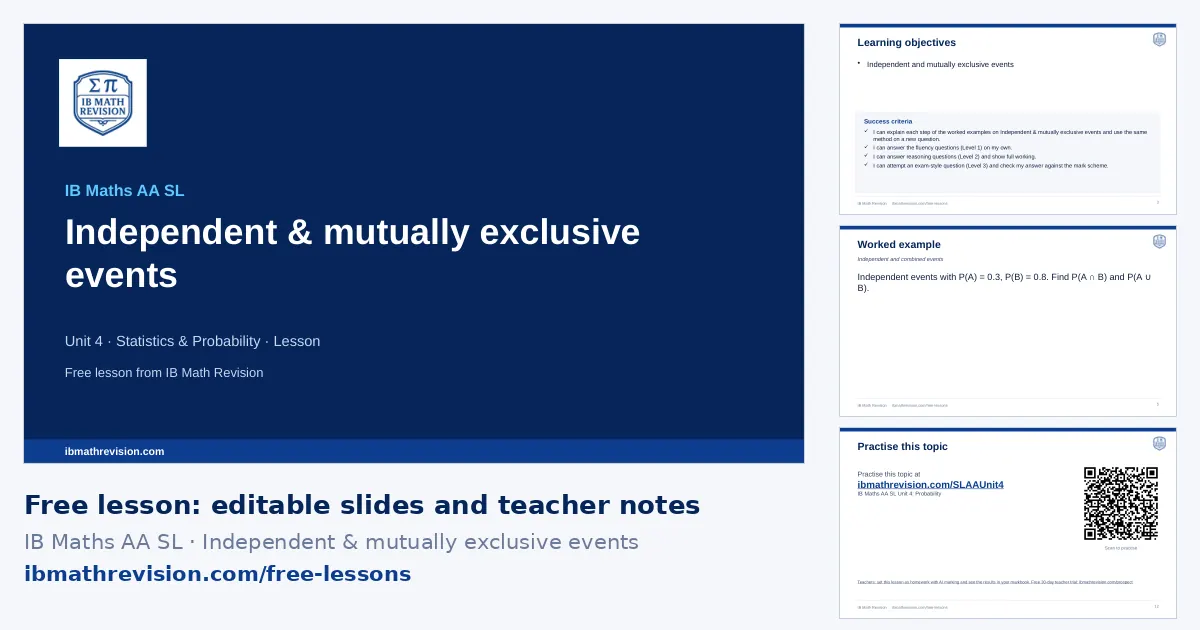
A ready-to-teach IB Maths AA SL lesson on Independent & mutually exclusive events (Unit 4 · Statistics & Probability): editable slides and teacher notes, free; a printable worksheet in 3 levels with answers for school plans. About 55 minutes.
Free with a teacher account. Sign in with Google, Microsoft or email and download the slides and teacher notes.
What's inside
- Slides (PowerPoint, editable) · freeabout 12 slides: do now, objectives, key ideas, a worked example step by step, “your turn”, practice QR code, exit ticket
- Teacher notes (PDF) · freelesson plan with timings, common mistakes, homework links
- Worksheet (PDF) · school plans6 questions, 26 marks: Fluency, Reasoning, Exam-style. Included with school plans and the teacher trial.
- Answers (PDF) · school plansthe answer to every worksheet question, from its mark scheme. Included with school plans and the teacher trial.
Learning objectives
- Independent and mutually exclusive events
Key ideas on the slides
- A and B are independent if P(A ∩ B) = P(A)P(B), equivalently P(A | B) = P(A).
- Mutually exclusive means P(A ∩ B) = 0; events with non-zero probabilities cannot be both independent and mutually exclusive.
- To test independence, calculate both sides and compare; state the conclusion.
- For independent events, P(A ∪ B) = P(A) + P(B) − P(A)P(B).
By the end of the lesson, students should be able to answer a question like: If P(A)=0.3, P(B)=0.4, and P(A∩B)=0, are A and B mutually exclusive?
Key vocabulary
- independent: One event happening does not change the probability of the other.
- mutually exclusive: The events cannot happen together.
- intersection: A ∩ B: both events happen.
Common mistakes this lesson tackles
- Probability: assuming independence, and conditional probability with complements. Only multiply when independence is given or proved. Find P(A ∩ B) from the addition rule or a Venn diagram, then use P(A | B) = P(A ∩ B)/P(B), writing the events in context.
- Mixing up independent and mutually exclusive.
- Assuming independence to calculate P(A ∩ B) without it being given.
- Testing independence with an unsupported statement instead of the numbers.
The worked example
Independent events with P(A) = 0.3, P(B) = 0.8. Find P(A ∩ B) and P(A ∪ B).
- Independence: P(A ∩ B) = 0.3 × 0.8 = 0.24.
- Addition rule: P(A ∪ B) = 0.3 + 0.8 − 0.24 = 0.86.
Tip: Independent (probabilities multiply) is NOT the same as mutually exclusive (intersection is zero). Read the wording carefully.
Calculator tips
- No GDC step: show P(A)P(B) and P(A ∩ B).
Where this lesson fits
Independent & mutually exclusive events is in Unit 4 · Statistics & Probability of the IB Maths AA SL scheme of work.
- The lesson before: Conditional probability (scheme-of-work lessons: Conditional Probability; Conditional Probability Formally & Testing for Independence)
- The next lesson: Discrete random variables & E(X) (scheme-of-work lessons: Probability Distributions & E(X); Unknown Probabilities, E(X) & Fair Games)
Lesson plan
| 0–5 min | Do now: students write down what they remember about Conditional probability and Sample-space diagrams & tree diagrams |
| 5–8 min | Share the learning objective and success criteria |
| 8–20 min | Teach: the worked example, step by step; students copy the method |
| 20–25 min | Your turn: 1 mini-whiteboard question; check every board before moving on |
| 25–42 min | Practise: the worksheet (6 questions in 3 levels, with school plans and the teacher trial) or the topic's practice questions online; move up a level after two right in a row |
| 42–47 min | Plenary: 1-question exit ticket; collect it to plan the next lesson |
For students: practise this topic
The worksheet's QR code opens the IB Maths AA SL Unit 4: Probability practice questions.
With a school plan
Set Independent & mutually exclusive events as homework marked by AI, print this lesson's levelled worksheet with answers, and rebuild the lesson for your class with Create lesson. Free for 30 days as a teacher, no card.
Is it free, can I edit the slides, what do students use for homework? See questions teachers ask.