Free IB Maths AA SL lesson: Discriminant & roots
A ready-to-teach IB Maths AA SL lesson on Discriminant & roots (Unit 2 · Functions): editable slides and teacher notes, free; a printable worksheet in 3 levels with answers for school plans. About 55 minutes.
The discriminant tells students how many real roots a quadratic has without solving it. In AA SL it is used in three ways, and this lesson takes them in turn: deciding the number of roots, finding an unknown k for equal roots, and finding when a line is a tangent to a curve.
Free with a teacher account. Sign in with Google, Microsoft or email and download the slides and teacher notes.
What's inside
- Slides (PowerPoint, editable) · freeabout 12 slides: do now, objectives, key ideas, a worked example step by step, “your turn”, practice QR code, exit ticket
- Teacher notes (PDF) · freelesson plan with timings, common mistakes, homework links
- Worksheet (PDF) · school plans6 questions, 29 marks: Fluency, Reasoning, Exam-style. Included with school plans and the teacher trial.
- Answers (PDF) · school plansthe answer to every worksheet question, from its mark scheme. Included with school plans and the teacher trial.
Learning objectives
- The discriminant
Skills in this topic
Discriminant & roots breaks down into 2 skills. In the worksheet builder, teachers can set practice on just one of them.
- The discriminant and the number of roots: Use b² − 4ac to decide (or force) two, one or no real roots.
- Tangent lines & line–curve intersections: Set the line equal to the curve and use the discriminant for a tangent or intersections.
Worked example: Discriminant & roots
Find the values of m for which the line y = mx − 1 is a tangent to the curve y = x² + 3.
- Where they meet, x² + 3 = mx − 1, so x² − mx + 4 = 0.
- A tangent meets the curve at exactly one point, so this quadratic has a repeated root: Δ = 0.
- Δ = (−m)² − 4(1)(4) = m² − 16 = 0, so m² = 16.
Answer: m = 4 or m = −4
Common mistakes in discriminant & roots
- Using Δ > 0 when the question says 'real roots': real roots, possibly equal, means Δ ≥ 0.
- Finding the discriminant of the curve's equation instead of the quadratic you get after substituting the line.
- Keeping only the positive square root: m² = 16 gives m = 4 or m = −4.
The worked example
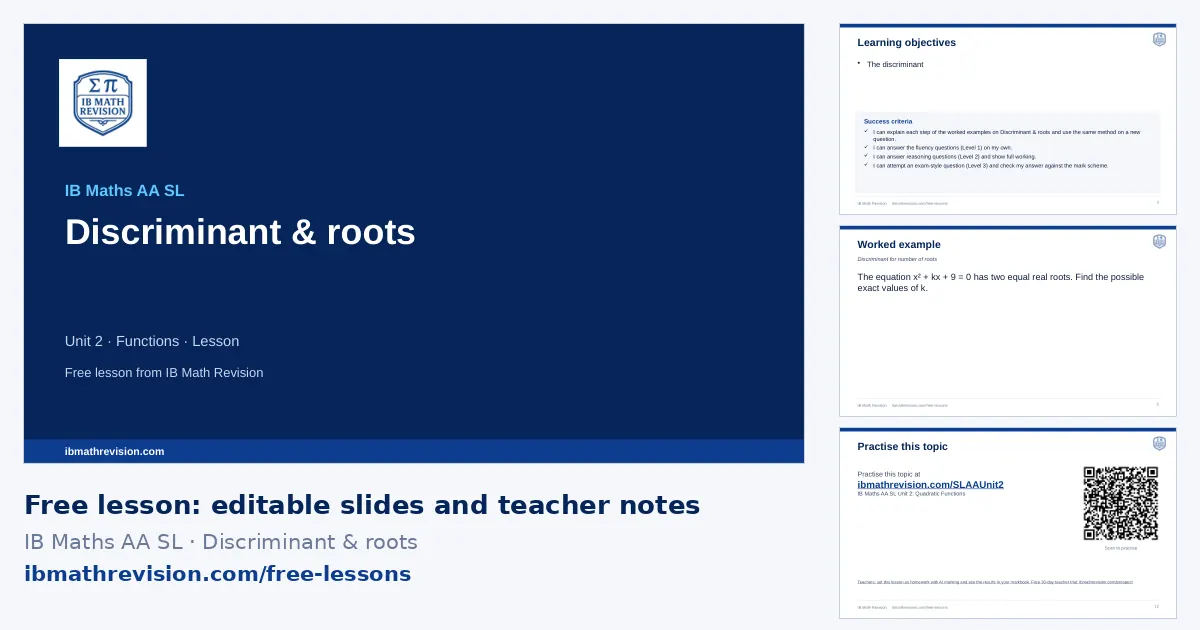
The equation x² + kx + 9 = 0 has two equal real roots. Find the possible exact values of k.
- Condition for equal roots: Δ = b² − 4ac = 0.
- Coefficients: a = 1, b = k, c = 9.
- Substitute: k² − 36 = 0 ⇒ k² = 36.
- Solve: k = ± 6.
Tip: "Two equal real roots", "touches the x-axis", and "is a perfect square" all signal setting the discriminant exactly to zero.
Where this lesson fits
Discriminant & roots is in Unit 2 · Functions of the IB Maths AA SL scheme of work.
- The lesson before: Quadratic graphs & vertex (scheme-of-work lessons: Quadratic functions and their graphs)
- The next lesson: Solving quadratics (factor, formula, complete square) (scheme-of-work lessons: Factorising & Completing the Square; The Quadratic Formula, Discriminant & Quadratic Inequalities)
Lesson plan
| 0–5 min | Do now: students write down what they remember about Quadratic graphs & vertex and Parallel & perpendicular lines |
| 5–8 min | Share the learning objective and success criteria |
| 8–20 min | Teach: the worked example, step by step; students copy the method |
| 20–25 min | Your turn: 1 mini-whiteboard question; check every board before moving on |
| 25–42 min | Practise: the worksheet (6 questions in 3 levels, with school plans and the teacher trial) or the topic's practice questions online; move up a level after two right in a row |
| 42–47 min | Plenary: 1-question exit ticket; collect it to plan the next lesson |
For students: practise this topic
The worksheet's QR code opens the IB Maths AA SL Unit 2: Quadratic Functions practice questions.
With a school plan
Set Discriminant & roots as homework marked by AI, print this lesson's levelled worksheet with answers, and rebuild the lesson for your class with Create lesson. Free for 30 days as a teacher, no card.
Is it free, can I edit the slides, what do students use for homework? See questions teachers ask.