Free IB Maths AA SL and AI HL lesson: Combined transformations
A ready-to-teach IB Maths AA SL and AI HL lesson on Combined transformations: editable slides and teacher notes, free; a printable worksheet in 3 levels with answers for school plans. About 55 minutes.
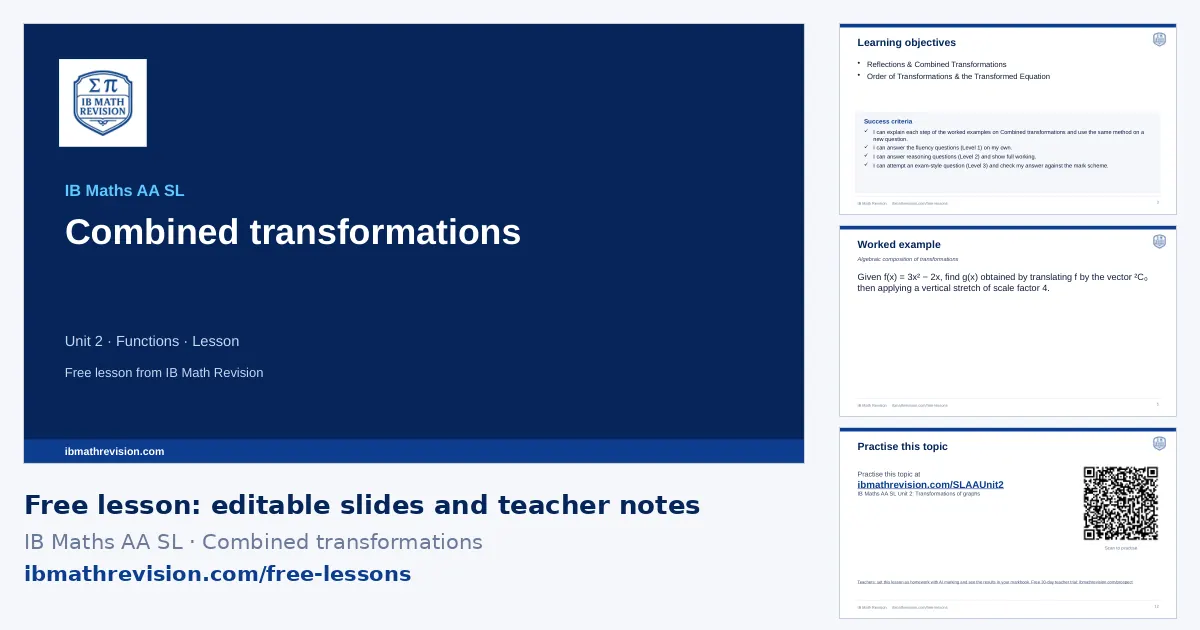
Free with a teacher account. Sign in with Google, Microsoft or email and download the slides and teacher notes.
One lesson for AA SL and AI HL
Combined transformations is taught in IB Maths AA SL and IB Maths AI HL, with the same key ideas. Choose your course above the download button: each version's slides use that course's own worked example, questions and practice link.
- AA SL (Unit 2 · Functions): Reflections & Combined Transformations; Order of Transformations & the Transformed Equation
- AI HL (Unit 2 · Functions): Transformations of graphs
What's inside
- Slides (PowerPoint, editable) · freeabout 12 slides: do now, objectives, key ideas, a worked example step by step, “your turn”, practice QR code, exit ticket
- Teacher notes (PDF) · freelesson plan with timings, common mistakes, homework links
- Worksheet (PDF) · school plans5 questions, 20 marks: Fluency, Reasoning, Exam-style. Included with school plans and the teacher trial.
- Answers (PDF) · school plansthe answer to every worksheet question, from its mark scheme. Included with school plans and the teacher trial.
Learning objectives (AA SL)
- Reflections & Combined Transformations
- Order of Transformations & the Transformed Equation
Key ideas on the slides
- y = f(x) + d: vertical translation by d; y = f(x − c): horizontal translation by +c (right for c > 0).
- y = af(x): vertical stretch, scale factor a; y = f(bx): horizontal stretch, scale factor 1/b.
- y = −f(x): reflection in the x-axis; y = f(−x): reflection in the y-axis.
- Describe each fully (type, direction, amount) and in order; changes to the output (outside) act as written, changes to the input (inside) act the opposite way.
By the end of the lesson, students should be able to answer a question like: Find the equation when y = x2 is translated then stretched vertically.
Skills in this topic
Combined transformations breaks down into 3 skills. In the worksheet builder, teachers can set practice on just one of them.
- Transforming a point: Apply a sequence of transformations to a point on a graph.
- Describing a combined transformation: Describe, in order, the transformations that map one graph to another.
- Writing the transformed function: Write the equation of a graph after a sequence of transformations.
Key vocabulary
- stretch: A scaling parallel to an axis by a scale factor.
- odd function: f(−x) = −f(x): rotational symmetry about the origin.
- even function: f(−x) = f(x): symmetric about the y-axis.
Common mistakes this lesson tackles
- Transformations and inverses: incomplete descriptions and f⁻¹ notation. Name each transformation with its type and value ("vertical stretch, scale factor 3"; "translation by the vector (2, 0)"), in a valid order. Rewrite logs with the laws first. f⁻¹(a) means solve f(x) = a.
- Moving f(x + 2) to the right.
- Stretching f(2x) by factor 2 instead of ½.
- Describing a transformation as "moves" or "shifts" without a direction and amount (or as a vector).
The worked example
Given f(x) = 3x² − 2x, find g(x) obtained by translating f by the vector ²C₀ then applying a vertical stretch of scale factor 4.
- Translation: replace x with (x − 2): f₁(x) = 3(x−2)² − 2(x−2).
- Expand: 3(x² − 4x + 4) − 2x + 4 = 3x² − 12x + 12 − 2x + 4 = 3x² − 14x + 16.
- Vertical stretch by 4: multiply the whole function by 4: g(x) = 4(3x² − 14x + 16).
- Distribute: g(x) = 12x² − 56x + 64.
Tip: Always place (x−c) inside parentheses before expanding; forgetting these brackets is the most common cause of transformation-expansion errors.
Calculator tips
- Plot the original and the transformed functions together to check.
Where this lesson fits
Combined transformations is in Unit 2 · Functions of the IB Maths AA SL scheme of work.
- The lesson before: Solving quadratics (factor, formula, complete square) (scheme-of-work lessons: Factorising & Completing the Square; The Quadratic Formula, Discriminant & Quadratic Inequalities)
- The next lesson: Rational functions & asymptotes (scheme-of-work lessons: Reciprocal Graphs & Asymptotes; Graphing y = (ax+b)/(cx+d); Solving Rational Equations)
Lesson plan
| 0–5 min | Do now: students write down what they remember about Vertical + horizontal stretches and Vertical + horizontal shifts |
| 5–8 min | Share the learning objective and success criteria |
| 8–20 min | Teach: the worked example, step by step; students copy the method |
| 20–25 min | Your turn: 1 mini-whiteboard question; check every board before moving on |
| 25–42 min | Practise: the worksheet (5 questions in 3 levels, with school plans and the teacher trial) or the topic's practice questions online; move up a level after two right in a row |
| 42–47 min | Plenary: 1-question exit ticket; collect it to plan the next lesson |
For students: practise this topic
The worksheet's QR code opens your course's practice questions:
- IB Maths AA SL Unit 2: Transformations of graphs practice questions
- IB Maths AI HL Unit 2: Graphing Linear, Quadratic, Exponential and Logarithmic Functions practice questions
With a school plan
Set Combined transformations as homework marked by AI, print this lesson's levelled worksheet with answers, and rebuild the lesson for your class with Create lesson. Free for 30 days as a teacher, no card.
Is it free, can I edit the slides, what do students use for homework? See questions teachers ask.