Free IB Maths AA HL lesson: Variance of a discrete random variable; E(aX + b) & Var(aX + b)
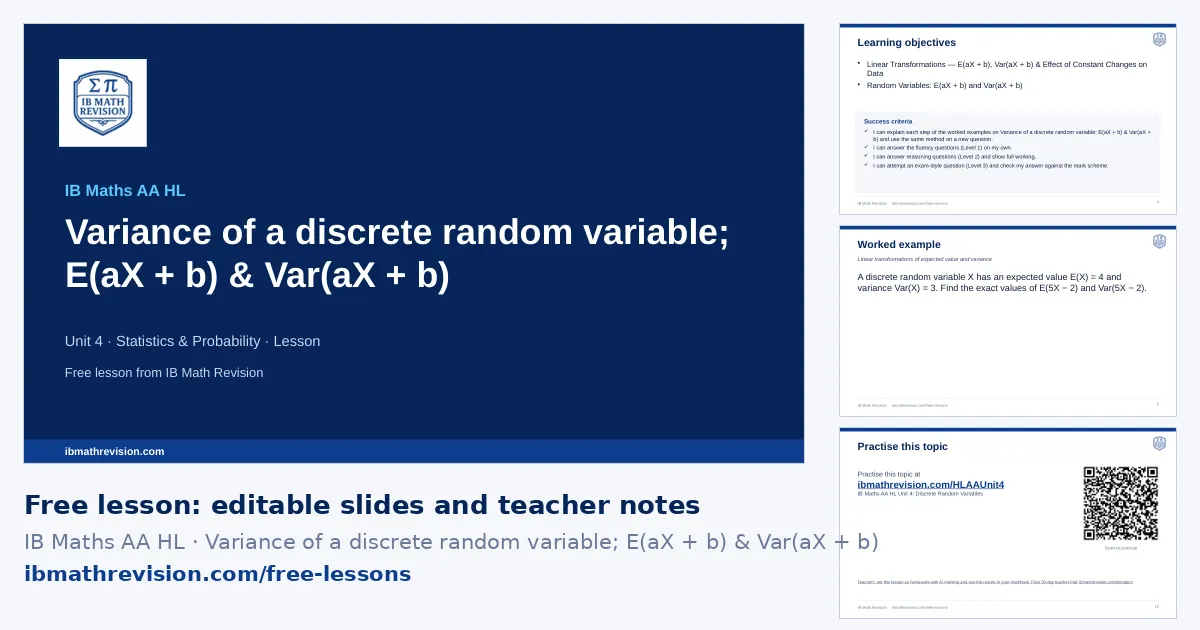
A ready-to-teach IB Maths AA HL lesson on Variance of a discrete random variable; E(aX + b) & Var(aX + b) (Unit 4 · Statistics & Probability): editable slides and teacher notes, free; a printable worksheet in 3 levels with answers for school plans. About 55 minutes.
This HL lesson finds the variance of a discrete random variable from its table, with Var(X) = E(X²) − [E(X)]², and then the mean and variance of a linear change aX + b, such as a prize that is a fixed multiple of a score minus an entry fee.
Free with a teacher account. Sign in with Google, Microsoft or email and download the slides and teacher notes.
What's inside
- Slides (PowerPoint, editable) · freeabout 12 slides: do now, objectives, key ideas, a worked example step by step, “your turn”, practice QR code, exit ticket
- Teacher notes (PDF) · freelesson plan with timings, common mistakes, homework links
- Worksheet (PDF) · school plans6 questions, 33 marks: Fluency, Reasoning, Exam-style. Included with school plans and the teacher trial.
- Answers (PDF) · school plansthe answer to every worksheet question, from its mark scheme. Included with school plans and the teacher trial.
Learning objectives
- Linear Transformations — E(aX + b), Var(aX + b) & Effect of Constant Changes on Data
- Random Variables: E(aX + b) and Var(aX + b)
Worked example: Variance of a discrete random variable; E(aX + b) & Var(aX + b)
E(X) = 2.5 and Var(X) = 1.2. Find E(4 − 3X) and Var(4 − 3X).
- E(aX + b) = aE(X) + b: E(4 − 3X) = 4 − 3 × 2.5 = −3.5.
- Var(aX + b) = a²Var(X): the 4 does not change the spread.
- Var(4 − 3X) = (−3)² × 1.2 = 10.8.
Answer: E(4 − 3X) = −3.5, Var(4 − 3X) = 10.8
Common mistakes in variance of a discrete random variable; E(aX + b) & Var(aX + b)
- Adding the constant to the variance: b moves the values, not their spread.
- Using a instead of a², or keeping its sign: Var(−3X) = 9Var(X).
- Writing Var(X) = E(X²) − E(X): the mean must be squared.
The worked example
A discrete random variable X has an expected value E(X) = 4 and variance Var(X) = 3. Find the exact values of E(5X − 2) and Var(5X − 2).
- Identify the rule for the expected value of a linear transformation: E(aX + b) = aE(X) + b.
- Substitute the given expected value into the formula: E(5X − 2) = 5(4) − 2.
- Evaluate the expected value: 20 − 2 = 18.
- Identify the rule for the variance of a linear transformation: Var(aX + b) = a²Var(X).
- Substitute the given variance into the formula: Var(5X − 2) = 5²(3) = 25(3).
- Evaluate to find the final exact variance: E(5X − 2) = 18 and Var(5X − 2) = 75.
Tip: A very common mistake is incorrectly subtracting the constant b from the variance or forgetting to square the coefficient a when applying the variance transformation rule.
Where this lesson fits
Variance of a discrete random variable; E(aX + b) & Var(aX + b) is in Unit 4 · Statistics & Probability of the IB Maths AA HL scheme of work.
- The lesson before: Sampling techniques & bias awareness (scheme-of-work lessons: Populations, samples and sampling techniques)
- The next lesson: Continuous random variables (pdf, cdf) (scheme-of-work lessons: Probability Density Functions; Mode, Median & Probabilities from a pdf; Piecewise pdfs & Linear Transformations)
Lesson plan
| 0–5 min | Do now: students write down what they remember about Discrete random variables & E(X) and Independent & mutually exclusive events |
| 5–8 min | Share the learning objective and success criteria |
| 8–20 min | Teach: the worked example, step by step; students copy the method |
| 20–25 min | Your turn: 1 mini-whiteboard question; check every board before moving on |
| 25–42 min | Practise: the worksheet (6 questions in 3 levels, with school plans and the teacher trial) or the topic's practice questions online; move up a level after two right in a row |
| 42–47 min | Plenary: 1-question exit ticket; collect it to plan the next lesson |
For students: practise this topic
The worksheet's QR code opens the IB Maths AA HL Unit 4: Discrete Random Variables practice questions.
With a school plan
Set Variance of a discrete random variable; E(aX + b) & Var(aX + b) as homework marked by AI, print this lesson's levelled worksheet with answers, and rebuild the lesson for your class with Create lesson. Free for 30 days as a teacher, no card.
Is it free, can I edit the slides, what do students use for homework? See questions teachers ask.