Free IB Maths AA HL lesson: Definite integrals & area between curves
A ready-to-teach IB Maths AA HL lesson on Definite integrals & area between curves (Unit 5 · Calculus): editable slides and teacher notes, free; a printable worksheet in 3 levels with answers for school plans. About 55 minutes.
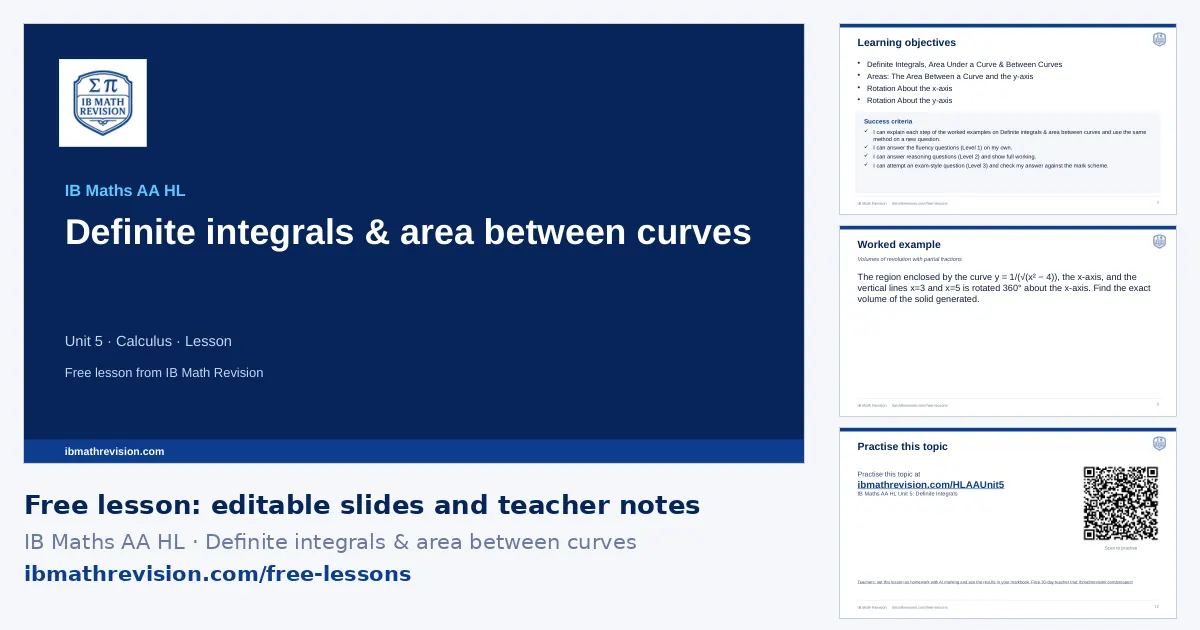
Free with a teacher account. Sign in with Google, Microsoft or email and download the slides and teacher notes.
What's inside
- Slides (PowerPoint, editable) · freeabout 12 slides: do now, objectives, key ideas, a worked example step by step, “your turn”, practice QR code, exit ticket
- Teacher notes (PDF) · freelesson plan with timings, common mistakes, homework links
- Worksheet (PDF) · school plans6 questions, 30 marks: Fluency, Reasoning, Exam-style. Included with school plans and the teacher trial.
- Answers (PDF) · school plansthe answer to every worksheet question, from its mark scheme. Included with school plans and the teacher trial.
Learning objectives
- Definite Integrals, Area Under a Curve & Between Curves
- Areas: The Area Between a Curve and the y-axis
- Rotation About the x-axis
- Rotation About the y-axis
Key ideas on the slides
- ∫ₐᵇ f(x) dx = F(b) − F(a), where F is an antiderivative; no +C is needed.
- For f(x) ≥ 0, ∫ₐᵇ f(x) dx is the area between the curve, the x-axis and x = a, x = b.
- Areas below the x-axis give negative integrals: split at the roots and add the absolute values: area = ∫ₐᵇ |f(x)| dx.
- Area between a curve and the y-axis: ∫_cᵈ x dy.
By the end of the lesson, students should be able to answer a question like: Calculate the area bounded by the curves y = x2 and y = x.
Skills in this topic
Definite integrals & area between curves breaks down into 2 skills. In the worksheet builder, teachers can set practice on just one of them.
- Evaluating definite integrals
- Area under & between curves
Key vocabulary
- definite integral: An integral with limits; its value is a number.
- limits: The values a and b between which you integrate.
- area: Always positive, even when the integral is negative.
- bounded region: A region enclosed by curves and/or lines.
- point of intersection: Where two curves meet; gives the limits.
Common mistakes this lesson tackles
- Volumes of revolution and areas: wrong axis, missing π or square, wrong limits. About the y-axis: V = π∫ x² dy, so rewrite x² in terms of y and use y-limits. Sketch the region first, then evaluate on the GDC unless an exact answer is required.
- Arithmetic with limits, fractions and simultaneous equations on Paper 1. Write F(upper) − F(lower) with each value in brackets before simplifying. Keep fractions as fractions. Check a simultaneous-equation solution by substituting back.
- Integrating across a root and letting positive and negative parts cancel.
- Substituting the limits into f instead of into F.
The worked example
The region enclosed by the curve y = 1/(√(x² − 4)), the x-axis, and the vertical lines x=3 and x=5 is rotated 360° about the x-axis. Find the exact volume of the solid generated.
- State the formula for a volume of revolution about the x-axis: V = π ∫ₐᵇ y² dx.
- Square the function and set up the integral: V = π ∫₃⁵ 1/(x² − 4) dx.
- Factorise the denominator and split into partial fractions: (1/((x−2)(x+2))) ≡ A/(x−2) + B/(x+2). Solving gives A = ¼ and B = −¼.
- Rewrite the integral using the partial fractions: V = (π/4) ∫₃⁵ (1/(x−2) − 1/(x+2)) dx.
- Integrate to log forms: (π/4) [ln|x−2| − ln|x+2|]₃⁵.
- Evaluate the limits and simplify using log laws: (π/4) ((ln 3 − ln 7) − (ln 1 − ln 5)) = (π/4) (ln 3/7 + ln 5) = (π/4) ln (15/7).
Tip: Ensure you physically square the function y before attempting to decompose it into partial fractions. Doing partial fractions on y and then squaring the result creates cross-terms that are much harder to integrate!
Calculator tips
- Use ∫ f(x) dx on the GDC; for area integrate the absolute value, abs(f(x)).
- Graph both, use intersect for the limits, then ∫(f − g) dx.
Where this lesson fits
Definite integrals & area between curves is in Unit 5 · Calculus of the IB Maths AA HL scheme of work.
- The lesson before: Related rates of change (scheme-of-work lessons: Related (connected) rates of change)
- The next lesson: Separable first-order DEs (scheme-of-work lessons: Differential equations: separating the variables)
Lesson plan
| 0–5 min | Do now: students write down what they remember about Antiderivatives (integration) and Optimisation in context |
| 5–8 min | Share the learning objective and success criteria |
| 8–20 min | Teach: the worked example, step by step; students copy the method |
| 20–25 min | Your turn: 1 mini-whiteboard question; check every board before moving on |
| 25–42 min | Practise: the worksheet (6 questions in 3 levels, with school plans and the teacher trial) or the topic's practice questions online; move up a level after two right in a row |
| 42–47 min | Plenary: 1-question exit ticket; collect it to plan the next lesson |
For students: practise this topic
The worksheet's QR code opens the IB Maths AA HL Unit 5: Definite Integrals practice questions.
With a school plan
Set Definite integrals & area between curves as homework marked by AI, print this lesson's levelled worksheet with answers, and rebuild the lesson for your class with Create lesson. Free for 30 days as a teacher, no card.
Is it free, can I edit the slides, what do students use for homework? See questions teachers ask.