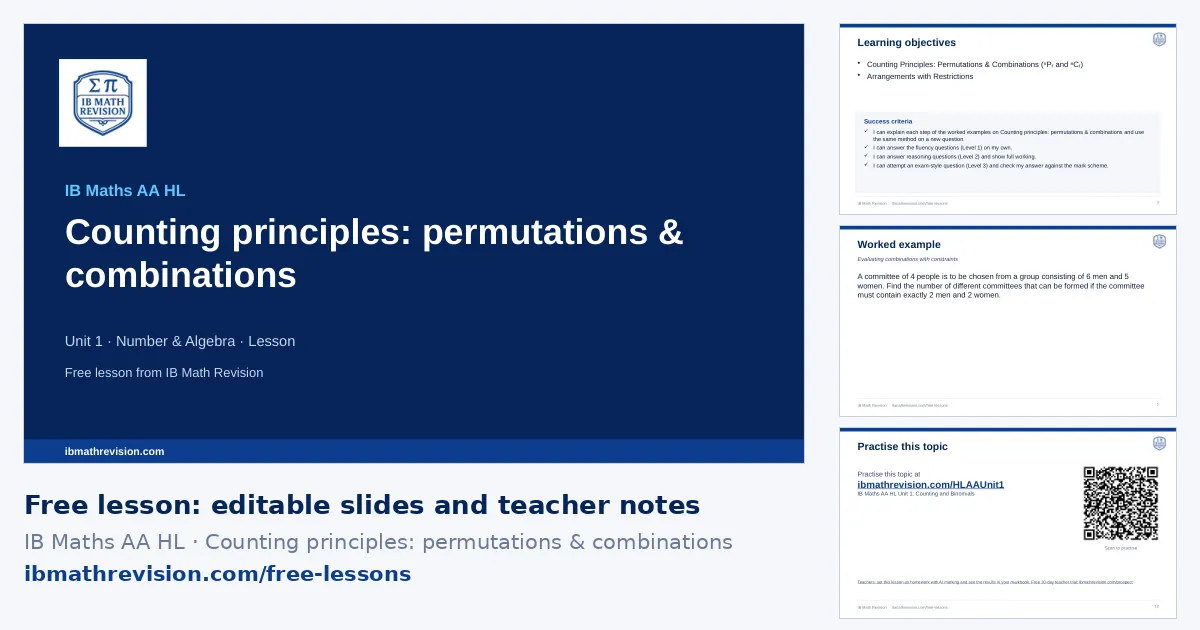
Free IB Maths AA HL lesson: Counting principles: permutations & combinations
A ready-to-teach IB Maths AA HL lesson on Counting principles: permutations & combinations (Unit 1 · Number & Algebra): editable slides and teacher notes, free; a printable worksheet in 3 levels with answers for school plans. About 55 minutes.
Free with a teacher account. Sign in with Google, Microsoft or email and download the slides and teacher notes.
What's inside
- Slides (PowerPoint, editable) · freeabout 12 slides: do now, objectives, key ideas, a worked example step by step, “your turn”, practice QR code, exit ticket
- Teacher notes (PDF) · freelesson plan with timings, common mistakes, homework links
- Worksheet (PDF) · school plans6 questions, 29 marks: Fluency, Reasoning, Exam-style. Included with school plans and the teacher trial.
- Answers (PDF) · school plansthe answer to every worksheet question, from its mark scheme. Included with school plans and the teacher trial.
Learning objectives
- Counting Principles: Permutations & Combinations (ⁿPᵣ and ⁿCᵣ)
- Arrangements with Restrictions
Key ideas on the slides
- Multiplication principle: if one choice can be made in m ways and a second in n ways, together there are mn ways.
- Arrangements of n different objects: n!; of r from n (order matters): ⁿPᵣ = (n!)/((n−r)!).
- Selections of r from n (order does not matter): ⁿCᵣ = ⁿCᵣ = (n!)/(r!(n−r)!).
- Restrictions: place the restricted items first; for "together", treat them as one block; for "not together", subtract from the total.
By the end of the lesson, students should be able to answer a question like: In how many ways can 3 people be chosen from 10 to form a committee?
Key vocabulary
- permutation: An arrangement where order matters.
- combination: A selection where order does not matter.
- factorial: n! = n(n−1)… 2 × 1, with 0! = 1.
Common mistakes this lesson tackles
- Using combinations when the order matters (e.g. a president and a secretary).
- Adding the choices when they should be multiplied.
- Forgetting to multiply by the internal arrangements of a block.
The worked example
A committee of 4 people is to be chosen from a group consisting of 6 men and 5 women. Find the number of different committees that can be formed if the committee must contain exactly 2 men and 2 women.
- Identify that the selection order within a committee does not matter, meaning combinations (nCr) should be used.
- Calculate the number of ways to independently choose 2 men from 6: ⁶C₂ = (6!)/(2!(6−2)!) = 15.
- Calculate the number of ways to independently choose 2 women from 5: ⁵C₂ = (5!)/(2!(5−2)!) = 10.
- Apply the fundamental counting principle by multiplying the number of options for these independent events together.
- Evaluate the final product: 15 × 10 = 150.
Tip: Students frequently confuse permutations with combinations; look out for keywords like "committee" or "group" which universally indicate that the internal order of selection is irrelevant and combinations should be used.
Calculator tips
- Use the nPr and nCr keys; check small cases by listing.
Where this lesson fits
Counting principles: permutations & combinations is in Unit 1 · Number & Algebra of the IB Maths AA HL scheme of work.
- The lesson before: Partial fractions (linear & repeated factors) (scheme-of-work lessons: Partial fractions)
- The next lesson: Discriminant & the number of real roots (scheme-of-work lessons: The discriminant)
Lesson plan
| 0–5 min | Do now: students write down what they remember about Direct proof & algebraic identities and Partial fractions (linear & repeated factors) |
| 5–8 min | Share the learning objective and success criteria |
| 8–20 min | Teach: the worked example, step by step; students copy the method |
| 20–25 min | Your turn: 1 mini-whiteboard question; check every board before moving on |
| 25–42 min | Practise: the worksheet (6 questions in 3 levels, with school plans and the teacher trial) or the topic's practice questions online; move up a level after two right in a row |
| 42–47 min | Plenary: 1-question exit ticket; collect it to plan the next lesson |
For students: practise this topic
The worksheet's QR code opens the IB Maths AA HL Unit 1: Counting and Binomials practice questions.
With a school plan
Set Counting principles: permutations & combinations as homework marked by AI, print this lesson's levelled worksheet with answers, and rebuild the lesson for your class with Create lesson. Free for 30 days as a teacher, no card.
Is it free, can I edit the slides, what do students use for homework? See questions teachers ask.