Free IB Maths AA HL lesson: Consistent, inconsistent & dependent systems
A ready-to-teach IB Maths AA HL lesson on Consistent, inconsistent & dependent systems (Unit 1 · Number & Algebra): editable slides and teacher notes, free; a printable worksheet in 3 levels with answers for school plans. About 55 minutes.
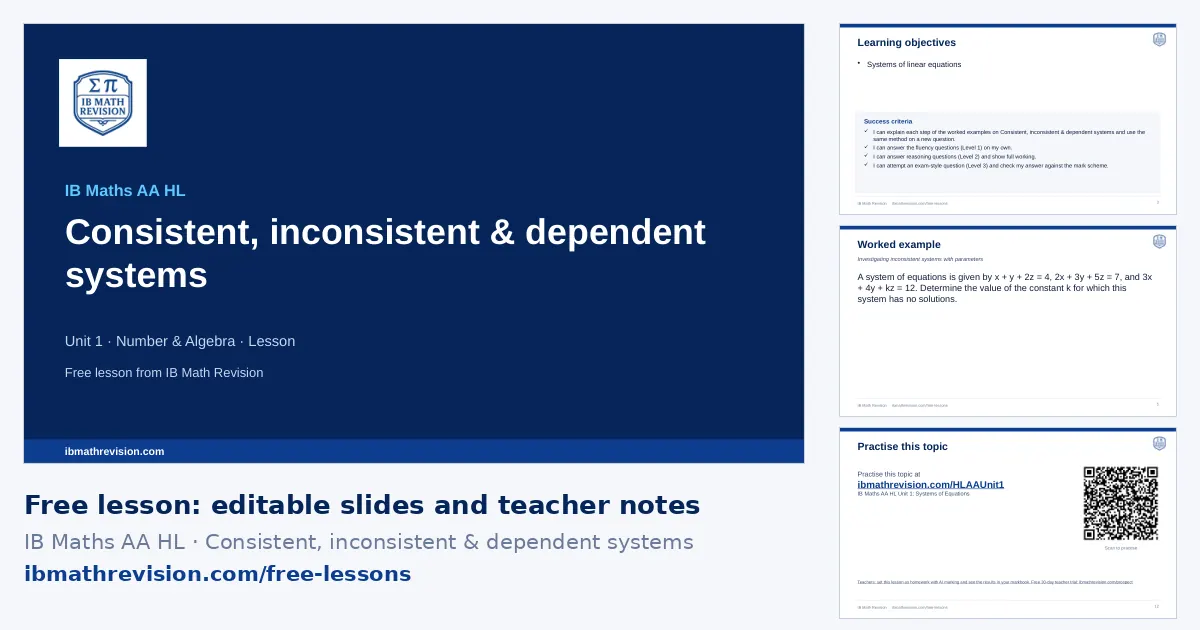
Free with a teacher account. Sign in with Google, Microsoft or email and download the slides and teacher notes.
What's inside
- Slides (PowerPoint, editable) · freeabout 12 slides: do now, objectives, key ideas, a worked example step by step, “your turn”, practice QR code, exit ticket
- Teacher notes (PDF) · freelesson plan with timings, common mistakes, homework links
- Worksheet (PDF) · school plans6 questions, 38 marks: Fluency, Reasoning, Exam-style. Included with school plans and the teacher trial.
- Answers (PDF) · school plansthe answer to every worksheet question, from its mark scheme. Included with school plans and the teacher trial.
Learning objectives
- Systems of linear equations
Key ideas on the slides
- A system of linear equations can have one solution, no solution (inconsistent) or infinitely many solutions (dependent).
- Solve 2×2 systems by elimination or substitution; 3×3 systems by elimination (to row-echelon form) or with the GDC.
- For a 3×3 system with a parameter, reduce to find when the last equation becomes 0 = 0 (infinitely many) or 0 = k ≠ 0 (none).
- For infinitely many solutions, give the general solution in terms of a parameter: x = 1 + 2λ, y = λ, z = 3 − λ.
By the end of the lesson, students should be able to answer a question like: Find k such that x+y+z=1, x+ky+z=2, 2x+y+kz=3 has no solution.
Key vocabulary
- consistent: Having at least one solution.
- inconsistent: Having no solution.
- parameter: A letter (such as λ) used to describe infinitely many solutions.
Common mistakes this lesson tackles
- Arithmetic with limits, fractions and simultaneous equations on Paper 1. Write F(upper) − F(lower) with each value in brackets before simplifying. Keep fractions as fractions. Check a simultaneous-equation solution by substituting back.
- Stopping at 0 = 0 without describing the infinitely many solutions.
- Arithmetic slips when eliminating; check in all three equations.
- Entering the equations into the GDC with a term in the wrong column.
The worked example
A system of equations is given by x + y + 2z = 4, 2x + 3y + 5z = 7, and 3x + 4y + kz = 12. Determine the value of the constant k for which this system has no solutions.
- Label the equations: (1) x + y + 2z = 4, (2) 2x + 3y + 5z = 7, (3) 3x + 4y + kz = 12.
- Eliminate x from equation (2) by calculating Eq(2) − 2 × Eq(1): (2x − 2x) + (3y − 2y) + (5z − 4z) = 7 − 8, yielding y + z = −1.
- Eliminate x from equation (3) by calculating Eq(3) − 3 × Eq(1): (3x − 3x) + (4y − 3y) + (kz − 6z) = 12 − 12.
- Simplify to yield a second equation in y and z: y + (k−6)z = 0.
- Subtract the result of step 2 from the result of step 4 to eliminate y: (y − y) + ((k−6)z − z) = 0 − (−1). This condenses to (k−7)z = 1.
- Analyze the final statement. For the system to have no solutions (geometrically, planes forming a triangular prism), we require an impossible statement such as 0z = 1. This occurs when the coefficient of z is zero, thus k = 7.
Tip: When finding conditions for infinitely many solutions or no solutions, systematically eliminate variables row-by-row to reach a final equation of the form az = b. If a=0 and b ≠ 0, there are no solutions.
Calculator tips
- Use the simultaneous-equation solver (or rref of the augmented matrix) and write down the system you entered.
Where this lesson fits
Consistent, inconsistent & dependent systems is in Unit 1 · Number & Algebra of the IB Maths AA HL scheme of work.
- The lesson before: 3×3 linear systems (GDC + elimination) (scheme-of-work lessons: Systems of linear equations)
- The next lesson: Partial fractions (linear & repeated factors) (scheme-of-work lessons: Partial fractions)
Lesson plan
| 0–5 min | Do now: students write down what they remember about 3×3 linear systems (GDC + elimination) and De Moivre & Euler form (roots of unity) |
| 5–8 min | Share the learning objective and success criteria |
| 8–20 min | Teach: the worked example, step by step; students copy the method |
| 20–25 min | Your turn: 1 mini-whiteboard question; check every board before moving on |
| 25–42 min | Practise: the worksheet (6 questions in 3 levels, with school plans and the teacher trial) or the topic's practice questions online; move up a level after two right in a row |
| 42–47 min | Plenary: 1-question exit ticket; collect it to plan the next lesson |
For students: practise this topic
The worksheet's QR code opens the IB Maths AA HL Unit 1: Systems of Equations practice questions.
With a school plan
Set Consistent, inconsistent & dependent systems as homework marked by AI, print this lesson's levelled worksheet with answers, and rebuild the lesson for your class with Create lesson. Free for 30 days as a teacher, no card.
Is it free, can I edit the slides, what do students use for homework? See questions teachers ask.