Free IB Maths AA HL lesson: Compound-angle & double-angle identities
A ready-to-teach IB Maths AA HL lesson on Compound-angle & double-angle identities (Unit 3 · Geometry & Trigonometry): editable slides and teacher notes, free; a printable worksheet in 3 levels with answers for school plans. About 55 minutes.
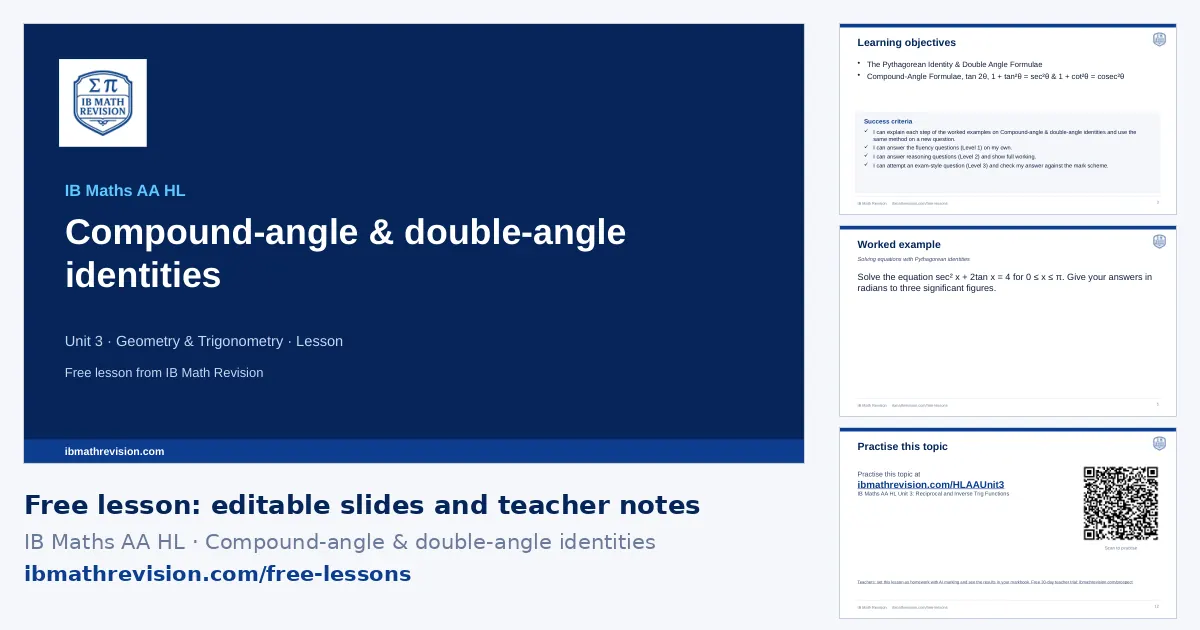
Free with a teacher account. Sign in with Google, Microsoft or email and download the slides and teacher notes.
What's inside
- Slides (PowerPoint, editable) · freeabout 12 slides: do now, objectives, key ideas, a worked example step by step, “your turn”, practice QR code, exit ticket
- Teacher notes (PDF) · freelesson plan with timings, common mistakes, homework links
- Worksheet (PDF) · school plans6 questions, 30 marks: Fluency, Reasoning, Exam-style. Included with school plans and the teacher trial.
- Answers (PDF) · school plansthe answer to every worksheet question, from its mark scheme. Included with school plans and the teacher trial.
Learning objectives
- Compound-angle (addition) formulae
Key ideas on the slides
- sin(A ± B) = sin Acos B ± cos Asin B.
- cos(A ± B) = cos Acos B ∓ sin Asin B (the sign swaps).
- tan(A ± B) = (tan A ± tan B)/(1 ∓ tan Atan B).
- Exact values: sin 75° = sin(45° + 30°) = (√6 + √2)/4.
By the end of the lesson, students should be able to answer a question like: Evaluate sin(75°) exactly by expanding the expression sin(45° + 30°).
Skills in this topic
Compound-angle & double-angle identities breaks down into 3 skills. In the worksheet builder, teachers can set practice on just one of them.
- Pythagorean identities & exact values
- Double-angle identities
- Compound-angle identities
Key vocabulary
- compound angle: An angle made of a sum or difference, such as A + B.
- addition formula: An identity expanding sin, cos or tan of a sum or difference.
- exact value: A value in surd form, not a decimal.
- double-angle formula: An identity writing a function of 2θ in terms of θ.
- factorise: Write as a product so that each factor can be set to zero.
Common mistakes this lesson tackles
- Trigonometric equations: missing solutions (obtuse, general or divided away). Sketch the function over the whole interval and count intersections before solving. Factorise rather than divide by a trig function (dividing loses the solutions where it is zero).
- Writing sin(A + B) = sin A + sin B.
- Using the same sign in the cosine formula (cos(A + B) has a minus).
- Mixing up which angle goes with which function in the product terms.
Calculator tips
- Check exact values with the calculator in degree mode.
- Graph both sides over the interval (radian mode) and count the intersections.
Where this lesson fits
Compound-angle & double-angle identities is in Unit 3 · Geometry & Trigonometry of the IB Maths AA HL scheme of work.
- The lesson before: Odd & even functions, self-inverse functions (scheme-of-work lessons: Composite functions)
- The next lesson: R-formula (asinθ + bcosθ) (extension) (scheme-of-work lessons: The harmonic form R cos(x ± α))
Lesson plan
| 0–5 min | Do now: students write down what they remember about Unit circle & exact values and Arc length & sector area |
| 5–8 min | Share the learning objective and success criteria |
| 8–20 min | Teach: the worked example, step by step; students copy the method |
| 20–25 min | Your turn: 1 mini-whiteboard question; check every board before moving on |
| 25–42 min | Practise: the worksheet (6 questions in 3 levels, with school plans and the teacher trial) or the topic's practice questions online; move up a level after two right in a row |
| 42–47 min | Plenary: 1-question exit ticket; collect it to plan the next lesson |
For students: practise this topic
The worksheet's QR code opens the IB Maths AA HL Unit 3: Reciprocal and Inverse Trig Functions practice questions.
With a school plan
Set Compound-angle & double-angle identities as homework marked by AI, print this lesson's levelled worksheet with answers, and rebuild the lesson for your class with Create lesson. Free for 30 days as a teacher, no card.
Is it free, can I edit the slides, what do students use for homework? See questions teachers ask.